The Air Compressor Spec Nobody Reads — Until the Tools Won't Run
The order that looked right on the requisition
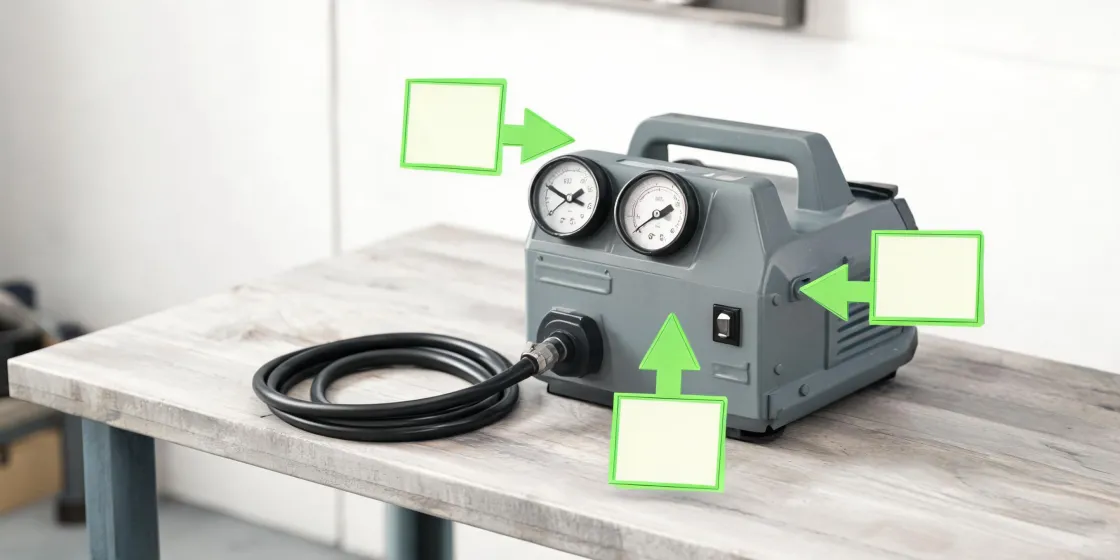
In April 2024 I signed off on a compressor for our maintenance shop. The spec line on my requisition form read: 25-gallon tank, 135 PSI max, ultra-quiet. Every box on that form got a checkmark. It was also, more or less, the wrong machine — not wrong enough to fail on day one, just wrong enough to make two people's jobs harder for about six weeks.
The first complaint came from the shop lead. He was pulling lug nuts off a service truck with a 1/2-inch impact wrench. The compressor would hit cut-in pressure, the wrench would hammer for maybe eight seconds, and then it would just sag. He'd finish the wheel on the second or third attempt. Same tool that had worked fine on the old 240V unit we were replacing.
The second complaint came from the grounds crew, about a box of air filters that didn't fit anything on the property. Not one mower, not the blower, not the compressor.
Two unrelated problems, I assumed. They weren't.
The number on the box is a category, not a spec
Here's what I got wrong, and I got it wrong for years: I treated a compressor's tank size and max pressure as performance numbers. They aren't. They're capacity and ceiling.
A 25-gallon tank tells you how much compressed air the machine can hold in reserve. The 135 PSI ceiling tells you where the pressure switch and safety valve are set to stop it. Neither number tells you how fast the pump refills the tank once a tool starts pulling air out of it. That's the number that decides whether an impact wrench hammers or wheezes, and it isn't printed on the front of the box in 48-point type.
CFM at 90 PSI is the number that runs the tool. Air tool makers publish required air consumption on the tool's spec page, and the honest figure is the one at operating pressure — usually listed as CFM at 90 PSI. Most 1/2-inch impact wrenches sit in the 4–6 CFM range. A dual-action sander can pull 15 CFM or more. A die grinder running continuously is not a small load either. Check the spec sheet for your specific tool — the range varies more than you'd expect between models with the same drive size.
The second half of that number is duty cycle. Our old unit was a belt-driven pump rated for continuous duty. The replacement was an oil-free direct-drive rated for intermittent use. Both are legitimate designs; they solve different problems. Oil-free direct-drive units are lighter, cheaper to own, and easier to place in a shop where nobody wants to change oil. Belt-driven cast-iron pumps handle long runtime without heat-soaking. I picked the wrong category for a workload that runs a sander and an impact back to back for two hours. That's on me, not on the machine.
Drive size is not torque
While I'm dismantling my own assumptions: if you're asking what size air impact wrench for lug nuts, the size people usually mean is the drive — the square anvil the socket snaps onto. 1/2-inch is the default for passenger vehicles and light trucks. 3/4-inch and 1-inch show up on heavier equipment. But drive size is the interface, not the capability.
What you actually need is the torque your service manual specifies. That's roughly 80–100 ft-lbs on most passenger cars and often 100–150 ft-lbs on light trucks and SUVs, but it varies by vehicle — check the manual, then verify with a torque wrench rather than trusting a hammer. Then you need a wrench whose rated torque is comfortably above that, plus enough air supply to actually produce it. Here's the fine print that burned us: impact torque ratings are measured at a stated supply pressure, and some manufacturers publish a loosening (reverse) figure because it's higher and sounds better. Under-supply the tool and you never get close to the number on the box. The wrench isn't weak. It's starving.
"Quiet" is a number with a distance attached
If a compressor is marketed as quiet and the spec sheet doesn't say dBA at a stated distance, treat it as a vibe rather than a measurement. Sound pressure falls off with distance, so "60 dB" means nothing until you know whether they measured it at three feet or thirty.
Why it matters operationally: OSHA's noise standard (29 CFR 1910.95) sets an 85 dBA eight-hour time-weighted average as the action level for a hearing conservation program. You can verify the current requirements at osha.gov. Even short of that threshold, a compressor running in a shared-wall shop generates complaints, forces earplugs, and dictates when you're allowed to run it. This is where brands in the ultra-quiet segment — California Air Tools among them — publish dBA figures per model, which is more useful than any adjective. Pull the current spec sheet for the specific model you're comparing; quiet isn't a brand-wide property, it's a measurement per unit.
I still get asked by other buyers whether stepping up to something like the 20060CAD makes sense for a two-bay shop. The honest answer is that it depends entirely on the CFM requirement of your biggest air consumer and how long it runs, not on the model number. Answer that question first and the model picks itself.
Then there's the filter that fits nothing
The filter problem had the same root cause, just wearing different clothes. A search for lawn mower air filter replacement and a search for a compressor intake filter both return results for "air filter." Those are different parts in different systems that happen to share a name. Cross-reference tables on generic shopping sites are often assembled by keyword, not by fitment, which is how you end up with a box of filters in a maintenance closet that satisfies no machine in the building.
On the compressor side it's worse, because the correct filter depends on the model and on the intake assembly — and whether the unit is oil-free or oil-lubricated changes what else you're buying at the same time (filter elements, oil, belts, pulleys, rebuild kits). None of that is guessable from a product title. It's all in the parts list.
What works: get the model and serial number off the machine's data plate, pull the manual, and buy by part number. If the manual is gone, the manufacturer's parts diagram is the authority. A distributor's page that says "compatible with" and doesn't list dimensions or an OEM number is a red flag until you confirm it.
What the misfires actually cost
Not the sticker price. Everything else.
- Time. Twenty minutes per wheel instead of five, twice a week, for six weeks. That's real labor hours, and it's invisible on any budget report.
- Risk. Under-torqued lug nuts because the wrench couldn't get there. Nobody measured it, which means the exposure sat there unquantified until we caught it.
- Returns and paperwork. Return freight, restocking fees, and the expense report. I once ate a vendor charge out of my own department budget because the receipt was handwritten and finance wouldn't touch it. I verify invoicing capability before I place an order now — every time, no exceptions.
- The trust problem. Worse than the money. The shop stopped trusting the requisition form and started buying their own consumables on a company card. That broke the budget in a way I couldn't see until the quarter closed.
The filters themselves were cheap — intake filters and small-engine filters generally land somewhere in the $10–30 range depending on the machine (ballpark based on typical distributor pricing as of January 2025; verify current pricing). The boxes of wrong ones cost shelf space and goodwill, not a fortune. The compressor was the expensive mistake, and it was expensive precisely because it almost worked.
How we spec it now
Shorter than the story, because the diagnosis did most of the work.
- Write the required CFM at 90 PSI on an index card for every air tool in the shop and tape it to the wall above the compressor. Largest consumer sets the floor.
- Spec the compressor on CFM, duty cycle, and dBA at a stated distance. Tank gallons and max PSI are footnotes, not headline criteria.
- Buy parts by OEM part number, never by product name. Model and serial first.
- Match the impact wrench to the torque the manual calls for, then check that the air supply can feed it. Torque wrench for final verification.
And one habit that isn't on the list but matters more than the rest. I keep calling the supply house that told me, flat out, that compressor intake filters weren't something they stocked for my model — and then sent me the part number and pointed me at who did have it. Two years later, they're still my first call for everything else. The distributor whose site promised "everything for your shop, one cart" shipped me the wrong filters twice. One of them told me what they don't do. The other told me what I wanted to hear. Guess which one cost less.

Maren Jorgensen
Maren Jorgensen is an independent hand tool and torque applications analyst covering wrenches, pliers, screwdrivers, hammers, sockets, ratchets, hex keys, and tool sets. She applies ISO 6789-1 torque-tool conformance principles while examining jaw capacity, leverage, fastener engagement, torque range, accuracy, handle geometry, and material hardness. Her practical guides help tradespeople and procurement teams select suitable tools, plan controlled tightening, and compare durability without relying on brand reputation alone.