Why the Cheapest 8-Gallon Air Compressor Cost Us More—And What I'd Buy Instead
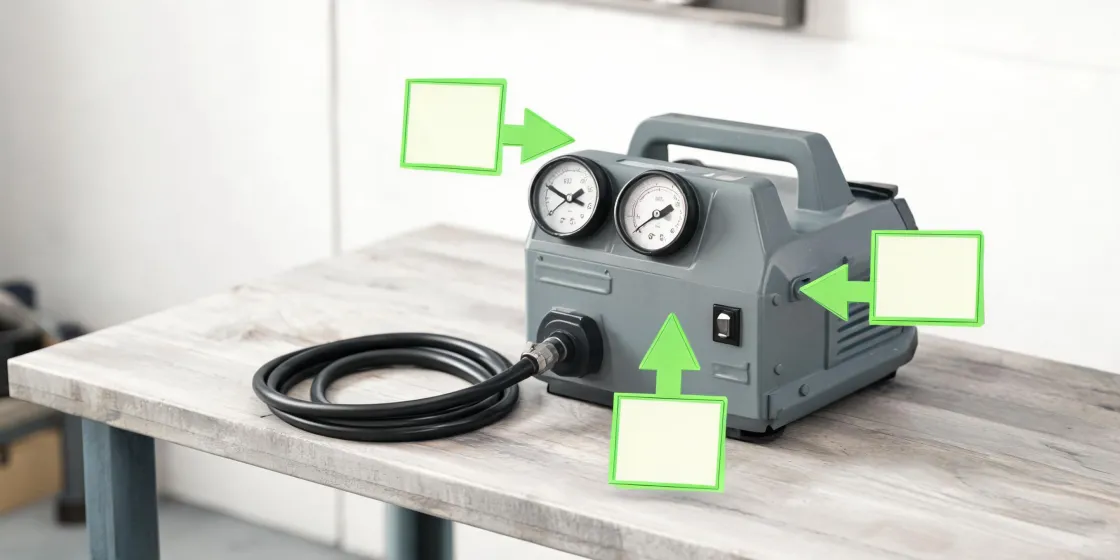
If you're shopping for an 8-gallon air compressor and the first spec you check is the tank, you're already looking at the wrong number. I say that as someone who bought two of them before I figured it out.
I manage procurement for a 24-person fabrication and cabinetry shop. Our tooling and shop equipment budget runs around $12,000 a year, and I've been tracking it in a spreadsheet since 2019. In 2021 I approved two budget 8-gallon units because the per-gallon price was unbeatable. By 2023 I'd replaced both of them—and the quiet replacements did more for our throughput than the extra capacity ever did.
That's my position, stated plainly: buy air compressors by decibels and CFM, not by tank size. Gallons are a marketing number. Everything else is a total-cost-of-ownership question.
Why "8 gallons" is a misleading headline
When people search for an 8-gallon air compressor, they're usually asking "how many tools can this run?"
That's the wrong question. The right one is: "how many nailers, sanders, or blow guns can this tank support continuously for 20 minutes?" The answer to that depends on CFM, not gallons. Tank size affects buffer—how long you can go between compressor cycles. For casual cabinet work, an 8-gallon tank with a 1 HP pump head is plenty. For a framing crew nailing all day, the recovery rate of the pump is your actual ceiling, not the tank.
When I compared two 8-gallon units side by side in 2022—same tank, different pump specs—the CFM difference at 90 PSI was close to 40%. That gap decided whether a crew kept working or stood around waiting.
That's the contrast insight I wish I'd had three years earlier: same category, wildly different real-world performance, and the spec sheet that buyers obsess over tells you almost nothing about it.
Noise is a TCO problem, not a comfort problem
Our older units measured around 89 dB at three feet. OSHA sets the 8-hour exposure threshold for hearing protection at 85 dBA, so we couldn't park those machines anywhere a person would stand for a full shift without either PPE or rotation.
Nobody wears earplugs if they can avoid it. So the compressor got pushed to the far end of the shop, connected to 50 feet of hose, which introduced pressure drop and a trip hazard. We spent—and I'm estimating here, though I remember the invoices clearly—somewhere between $800 and $1,200 over about two months on workarounds that all traced back to noise.
The replacement units run around 60 dB on paper. I measured with two different phone apps, which is not scientific, but the readings were consistent enough that I stopped caring about the method. You can talk over them at arm's length. The machine now lives 15 feet from the workbench, and nobody has to walk across the shop to flip it on.
For me, that's not a comfort upgrade. That's a time-savings line item.
The counterintuitive part: expensive compressors hold value
Here's the argument that budget buyers usually don't run: the machine you can't sell is the machine that costs you the most.
We offloaded the two cheap units in 2023 for $45 and $60 respectively. Nobody wanted to take a risk on used budget equipment. The quiet replacement had a dealer offering $140 on a trade-in after 18 months—and I wasn't even planning to sell it.
I'll grant that this is one data point. But stack the resale value against the noise payback and the relocation costs, and the math lands roughly in the same place: the quiet machine pays for the difference within about three years, then keeps paying after that.
So why doesn't everyone buy that way?
"But the quiet ones cost so much more"
Fair. Quiet 8-gallon units I've seen quoted run roughly $200–$260, versus $100–$160 for the standard tier (based on publicly listed dealer pricing, January 2025; verify current rates before you commit).
That's not nothing. But it's a comparison of sticker prices, not lifetimes.
If the gap is $90, and the loud machine gets pushed 40 feet away because nobody wants to stand next to it, you've burned through that $90 in less than a shift.
To the objection "we work outdoors, so noise doesn't matter"—that's legitimate if the compressor genuinely lives far from everyone. But for most fixed locations (cabinet shops, tire bays, machining cells, two-person garages), it stops being legitimate fast. That's been my experience, anyway.
And to "we've used the cheap one for years and it's fine"—also fair, and also true. Cheap compressors often don't break. The thing is, "doesn't break" and "works well" are separate claims. Ours never broke. We just hated using them.
Two maintenance notes, and one common confusion
Two things actually matter for longevity: draining condensate from the tank's bottom valve, and replacing the intake filter on schedule. That's most of it.
One clarification for anyone who ended up on this page from a mixed search: learning how to bleed air from a hydraulic jack is a completely different procedure. That's a hydraulic system—you open the release screw and cycle the handle to work trapped air out of the fluid. It has nothing to do with compressed air or a pressure tank. Both are scheduled maintenance. That's where the overlap ends.
What we actually kept
We settled on the California Air Tools 8010 for the main bench. It's an 8-gallon, 1 HP quiet unit—right size for intermittent to moderate nailing, and small enough that nobody has an excuse not to move it where it's needed.
For the machining side, where the pressure demand is more continuous, we went with a larger 20-gallon model—the 4620AC—because the trade-off there is portability in exchange for sustained output, and portability wasn't the priority.
If you're searching "2000 series air compressor" and bouncing between tabs, you're probably comparing the same handful of 8- to 10-gallon quiet models. Save yourself the tab-switching: the 8010 sits in that group, and it's the one that stayed bolted to our floor.
Where I land
I'm not going to tell you this is the cheapest way to buy air compressors. It isn't. And I'm certainly not going to tell you nothing ever breaks—things break.
My only argument is that per-gallon pricing and total cost of ownership are two different numbers that happen to share a unit. The "cheaper" machine, in our case, turned out to be the more expensive one. I paid for that lesson twice in four years.
If you take anything from this, take the question I now ask before any compressor purchase: not "how big is the tank," but "how close to people does this machine have to sit, and can they hear each other over it?"
Those two answers will reshape the rest of your buying criteria.

Rajiv Menon
Rajiv Menon is an independent rigging and lifting hardware analyst covering shackles, chain hoists, hooks, turnbuckles, wire-rope clips, and lifting attachments. He applies ISO 2415:2022 shackle requirements while evaluating working load limit, grade, proof load, design factor, pin fit, sling angle, reeving, brake behavior, identification, inspection, and temperature range. His safety-led guides help lifting teams and purchasers select compatible hardware, interpret markings, establish inspection criteria, and avoid side loading or undocumented substitutions.