The Friday Air Compressor Emergency That Nearly Went Sideways
Friday, 4:47 PM
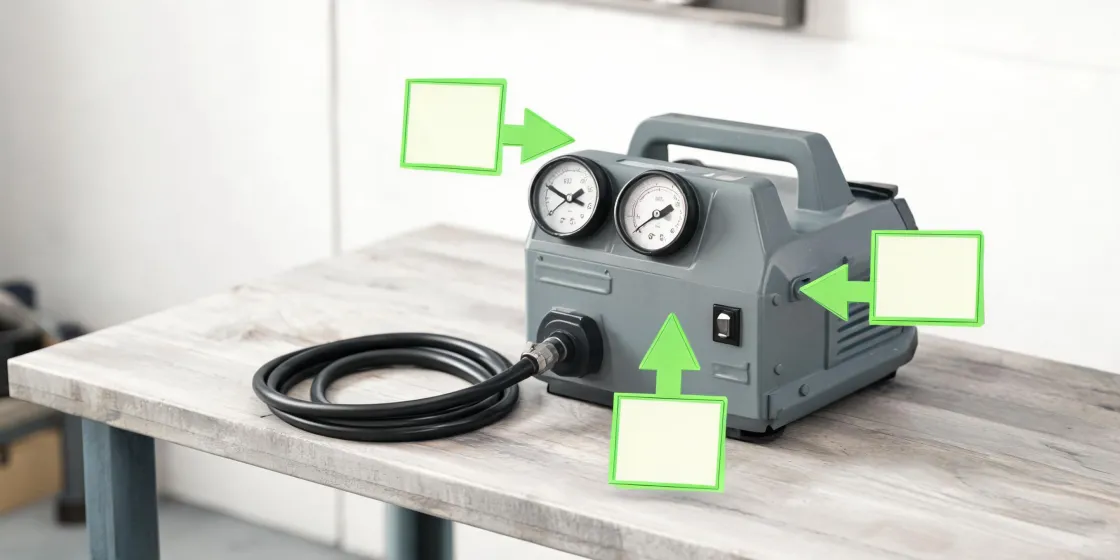
My phone rang at 4:47 PM on a Friday in March 2024. A general contractor I'd worked with for two years needed a replacement air compressor on a job site by Monday at 6 AM. His crew was tiling a wing of a hospital, and the compressor running their pneumatic tools had quit that afternoon mid-shift.
Normal turnaround on a specialty compressor order is five to seven business days. He had 61 hours. In my role coordinating rush orders for contractors and workshop clients, I've handled 200+ emergency jobs — last quarter alone, we processed 47 rush orders with a 95% on-time rate. So the first move wasn't panic. It was triage: figure out what the job actually needs, then find the shortest honest path to it.
The Assumption I've Had to Unlearn
When I first started sourcing equipment under deadline, I assumed a compressor was a compressor. Same PSI, right tank size, done. Ten years of rush orders later, I know that's about as wrong as it gets.
So I asked him three questions: What tools are you running? How heavy is the duty cycle? And what's the noise situation?
Turns out he was running pneumatic nailers and a couple of air impact wrenches. The impact wrench is the tool that zips lug nuts off a truck tire in about three seconds flat. It's also what you reach for on stubborn bolts in scaffolding, formwork, and heavy equipment. Translation for the sourcing side: it's a high-torque tool that wants way more CFM (cubic feet per minute of airflow) than a finishing nailer does.
And because the job was inside a hospital wing, there was a decibel ceiling. That's where "any compressor works" fell apart.
The Part I Almost Missed
He'd been running what he called his workhorse 3.5 air compressor — a 3.5 HP unit he'd owned for years — and it finally failed. His first instinct, like most people's, was to search "air compressor parts near me" and pick up a rebuild kit. Every local supply house came up empty. Plus, the pump itself was shot, so a kit wouldn't have saved him anyway.
I started pricing California Air Tools options. The 10020C California Air Tools model is a common pick for indoor work like this — ultra-quiet, which matters when you're two hallways from patient rooms. The California Air Tools 20015HP was another candidate for the airflow, but it was on backorder at every distributor I could reach before the weekend.
Here's the part that tripped me up at first. A 3.5 HP compressor feeding an impact wrench doesn't scale down neatly to a 1 HP quiet unit. You can't just swap and hope. The tool lineup has to change with the compressor, or the compressor won't keep up. From the outside, it looks like a rush order just means paying more for faster shipping. The reality is that rush jobs almost always require a different sourcing workflow — different vendors, different inventory decisions, different honesty with the client.
The Turning Point
This is where honesty saved the job. I could have sold him a big-box brand, said it would "probably work," and moved on. Instead I told him what I actually knew: I could get a California Air Tools unit to the site by Sunday night, but his crew would need to adjust their tool lineup for the first shift. The impact wrenches could wait until the larger unit landed Tuesday.
He took the deal. Then he asked a question I get a lot: "What is an air impact wrench used for, anyway — couldn't they just use a ratchet?" In a hospital wing with a hard deadline, no. Hand tools would have added hours to the job and blown the schedule.
The expedited shipping added $340 to the order (which, honestly, felt steep for a 30-mile run). But his tile crew was billing roughly $4,800 a day, so a one-day slip would have cost him far more than the freight charge.
Saturday Night, Sunday Morning
The compressor shipped Saturday afternoon. The driver called at 11 PM to confirm the drop-off window (note to self: always get the driver's cell, not the dispatch line). It landed Sunday at 9 AM — a solid six hours ahead of the deadline. The tile crew started on time Monday.
One detail worth flagging: the noise rating wasn't a luxury. According to OSHA, the permissible exposure limit for workplace noise is 90 dBA averaged over an 8-hour shift, with an action level at 85 dBA. Inside a hospital, we weren't worried about a citation — we were worried about a noise complaint shutting the job down. Ultra-quiet compressors run closer to the 60–70 dBA range at typical working distance, which is roughly the volume of a normal conversation.
What I Actually Learned
The moment that stuck with me wasn't the delivery. It was the call two weeks later, when he asked about rebuilding the dead pump. I told him straight: rebuilds aren't something I handle — I don't stock rebuild kits, and the pump was past a simple fix anyway. But California Air Tools' parts line covers that model, and here's the rep's direct number.
That's the whole thing. The vendor who says "this isn't our strength — here's who does it better" earns trust for everything else. I'd rather work with a specialist who knows their limits than a generalist who overpromises. As an emergency supplier, my job isn't to be the answer to everything. It's to know — fast — what I can actually deliver, and to be honest about the rest.
And one last thing that still surprises me: everything I'd read about handling rush orders said the answer was always "yes, and here's the premium." In practice, the supplier who says "yes, but here's what has to change" is the one who gets the call back.

Koji Sakamoto
Koji Sakamoto is an independent pneumatic tool and compressor analyst covering air compressors, impact wrenches, air ratchets, nail guns, and general air-tool systems. He applies ISO 11148 safety requirements while evaluating working pressure, free-air delivery, air consumption, hose loss, duty cycle, fastener capacity, vibration, noise, lubrication, and moisture control. His application guides help workshops and contractors size air supplies, compare tool output, and prevent performance losses caused by undersized or poorly maintained systems.