Don't Trust Peak Pressure Alone: A California Air Tools Buyer's Honest Lesson
-
Buy a System, Not Just a Compressor
-
Spec Sheets Tell You How Big, Not How Long
-
How I Read California Air Tools 8010 Specifications
-
An Air Tool Set Is a Collection, Not a System
-
The Short Answer to What Is Air Tool Oil
-
The Least Obvious Link: The Hose
-
But Isn't It Easier to Just Buy More Compressor?
-
Bottom Line: Buy the Whole System
If you're shopping by PSI alone, you're probably buying the wrong air tool before you start. That's not a knock against any compressor. It's a knock against how most of us first shop for air systems.
I'm a maintenance and equipment buyer. I've handled pneumatic tool orders for 11 years, and I've personally made—and documented—11 significant mistakes that cost roughly $6,300 in wasted budget. Now I maintain a purchasing checklist for our team. This article is that checklist translated into plain English.
I'd rather spend ten minutes explaining why a 4-gallon 135 psi compressor won't feed a hungry tool all day than process return shipping or an expensive repair later. An informed customer asks better questions. Better questions lead to fewer emergency adapter orders and fewer missed deadlines.
Buy a System, Not Just a Compressor
Here's my simple summary: an air compressor is one component of a system. The system also includes the air tool set, hose, fittings, regulator, moisture control, and a maintenance plan. A spec sheet describes one component. It does not describe how you'll work.
People think they're buying a compressor. Usually they're buying compatibility, and compatibility doesn't fit inside the box.
What most people don't realize is that air moves through a chain. The compressor creates flow, the tank stores air, the hose delivers it, the regulator controls it, and the tool uses it. If one link is weak, the tool at the end gets less than you expected.
Spec Sheets Tell You How Big, Not How Long
Max PSI tells you how much pressure the tank can hold. CFM at 90 PSI tells you how fast the pump can make more air. People treat PSI as a bragging number, but CFM is the number that keeps tools running.
The assumption is that a higher maximum pressure means more usable power. The reality is more complicated. You can have a tank full of pressure and still run out of air if the pump's flow rating is lower than the tool's demand.
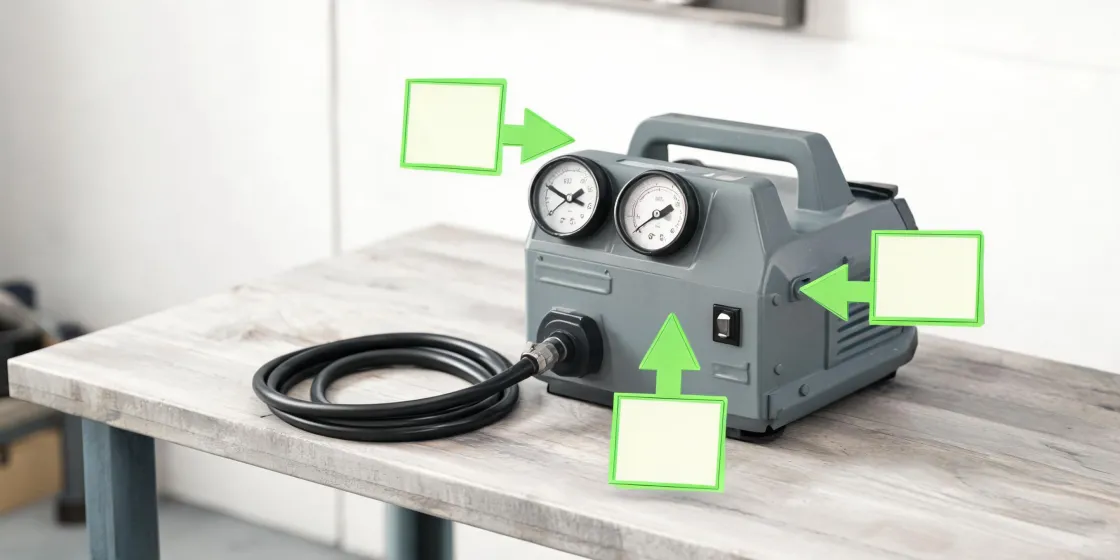
If someone asks whether an air compressor 4 gallon 135 psi model is enough, my response is: enough for what? For brad nailers, pin nailers, and light staplers, it can be perfect. For continuous-use air tools, the tank empties quickly and then the pump has to catch up.
A 4-gallon tank at 135 psi is a burst of stored energy, not an endless supply. The pump CFM determines how much more energy is on the way. When I see a review that focuses only on max pressure, I know the buyer is likely to be disappointed once a high-flow tool gets attached.
How I Read California Air Tools 8010 Specifications
I'm not going to turn this article into a replacement spec page. For the current California Air Tools 8010 specifications, check the manufacturer's product data. I want to talk about how to read a spec page without fooling yourself.
According to the product information published on the manufacturer site, CFM at 90 PSI and tank volume are there for each model. I look at those two lines first. Recovery and sound come after. Sound level matters in occupied spaces, but quiet is not a flow rating.
The same logic applies to the California Air Tools 1P1060SP. It has a different layout and a different role from the 8010, but the decision rule is the same. Match CFM to the actual tool list. If you buy for a specific job, you also need to know whether the compressor can keep going for the full task.
An Air Tool Set Is a Collection, Not a System
The phrase air tool set makes me stop and check the list before I order. A kit with many pieces can be a bargain. It can also be many pieces that don't belong in one workflow.
One mistake I made early: I ordered a complete-looking air tool set and assumed it would connect to our regulator without extra parts. It didn't. We waited on a small adapter while the crew stood around. The adapter was cheap. The lost hour wasn't.
Now I treat an air tool set like a parts list. Does it include oil? Does it include a case? Do the fittings match your hose? Do the tools' CFM requirements fit the compressor? If the answer is no, you haven't bought a system. You've bought a second trip to the hardware store.
The Short Answer to What Is Air Tool Oil
If you've searched what is air tool oil, you're already ahead of where I was. Air tool oil is a light oil that lubricates the moving parts inside pneumatic tools. You put a few drops into the tool's air inlet before connecting the hose, unless the tool has an automatic lubricator.
Why does it matter? Compressed air contains moisture. When air expands through a tool, moisture can condense and wash away lubricant. A few drops of oil reduces friction, protects steel parts, and helps keep the tool working.
Air tool oil is not compressor oil. If your compressor pump is advertised as oil-free, don't put oil into the pump. The oil goes in the tool or in an inline lubricator. And don't substitute engine oil or WD-40. Engine oil can be too heavy and can gum up a small air motor. WD-40 is not a lubricant substitute. Buy what the tool manual recommends; it costs a few dollars and saves expensive replacements.
The Least Obvious Link: The Hose
Here is the counterintuitive part. The most expensive compressor upgrade is sometimes not a compressor upgrade at all.
A long, narrow hose creates pressure drop. I've watched a compressor show full pressure while an air tool at the other end sounded weak. The tool wasn't bad. The air simply couldn't move through a restrictive line fast enough.
If you're working with a portable 4-gallon unit, test with the shortest practical hose that fits the job. You may find that the real problem was never the pump.
But Isn't It Easier to Just Buy More Compressor?
Fair challenge: if you oversize the compressor, you solve many CFM problems. I'm not against capacity. A shop running several high-consumption tools at once probably needs a larger compressor.
But bigger doesn't fix every mistake. It won't add oil to a dry nail gun. It won't make incompatible fittings compatible. It won't remove water from the tank if nobody drains it. And it won't help if the real bottleneck is a 50-foot undersized hose.
I also avoid pretending any machine is zero-maintenance. Many California Air Tools compressors use oil-free pumps, which is convenient. But even an oil-free pump sits on a tank that still needs to be drained. It has an intake filter that needs attention. Fewer maintenance points are not zero maintenance points.
Bottom Line: Buy the Whole System
If someone tells you a particular compressor is right without asking what tools you plan to run, don't trust that advice. The best answer isn't the biggest number on the box. It's whether the whole chain can deliver air to the tool and keep that tool lubricated.
When you look at California Air Tools 8010 specifications, when you hold the California Air Tools 1P1060SP on the shelf, or when you compare an air compressor 4 gallon 135 psi model, remember the rest of the chain. The truth I learned from my own wasted budget is this: an informed buyer makes better decisions. Informed buyers ask about air tool oil before they attach the first fitting. That's the habit I wish I had before my first mistake.

Maren Jorgensen
Maren Jorgensen is an independent hand tool and torque applications analyst covering wrenches, pliers, screwdrivers, hammers, sockets, ratchets, hex keys, and tool sets. She applies ISO 6789-1 torque-tool conformance principles while examining jaw capacity, leverage, fastener engagement, torque range, accuracy, handle geometry, and material hardness. Her practical guides help tradespeople and procurement teams select suitable tools, plan controlled tightening, and compare durability without relying on brand reputation alone.