Does a Cordless Nail Gun Need an Air Compressor? No—But Don't Buy the Wrong Power Source
The short answer
Look, the short answer is easy: No, a cordless nail gun does not need an air compressor. It runs on battery power, and some gas-assisted models also use a small fuel cell. If all you're buying is one nailer, you don't need a compressor. But that's not the same as saying a compressor is useless. The real question is which power source matches the tools you'll actually use.
Why does this matter? Because the wrong answer can send you down one of two expensive paths. Buy a battery nailer and then add a pneumatic tool later, and you'll be buying a compressor anyway. Buy a compressor and use it twice a year, and you'll wonder why you didn't just get a cordless unit.
Who's writing this
I'm the quality compliance manager at California Air Tools. Every compressor spec sheet has to match a production unit before it goes out the door. I review roughly 200+ unique configurations each year, and in Q1 2024 I rejected a batch because the published CFM at 90 PSI didn't match what we measured on the test bench. That's the perspective I'm bringing here: I care less about what a product is called and more about what it can actually do.
Here's the thing: when people ask 'does a cordless nail gun need an air compressor,' they're usually comparing two workflows. One workflow has a battery, a charger, and a case. The other has a tank, a hose, and a regulator. Both can drive a finish nailer. They just have different costs and different limits.
What people get backwards
The assumption is that cordless nail guns are always the cheaper route because they don't need a compressor. Actually, the cost doesn't disappear—it moves into batteries. A spare battery for a popular cordless trim nailer can be significant. I want to say the genuine ones run from $150 to $250 depending on the brand, but don't quote me on the exact number.
The second assumption is that a mini air compressor can't drive nails. That's only true if you look at the wrong tool. A 1.5 gallon air compressor with enough CFM at the tool's operating pressure can drive brad nails and pin nails all day because those tools use air in short bursts. Tank size is reserve capacity, not raw power. Put another way: a big tank with weak airflow will still starve a nailer if the hose is long and the regulator is set wrong.
When a 1.5 gallon air compressor is the right call
California Air Tools makes two models that show up in this comparison again and again: the CAT-10020C and the CAT-60040CAD.
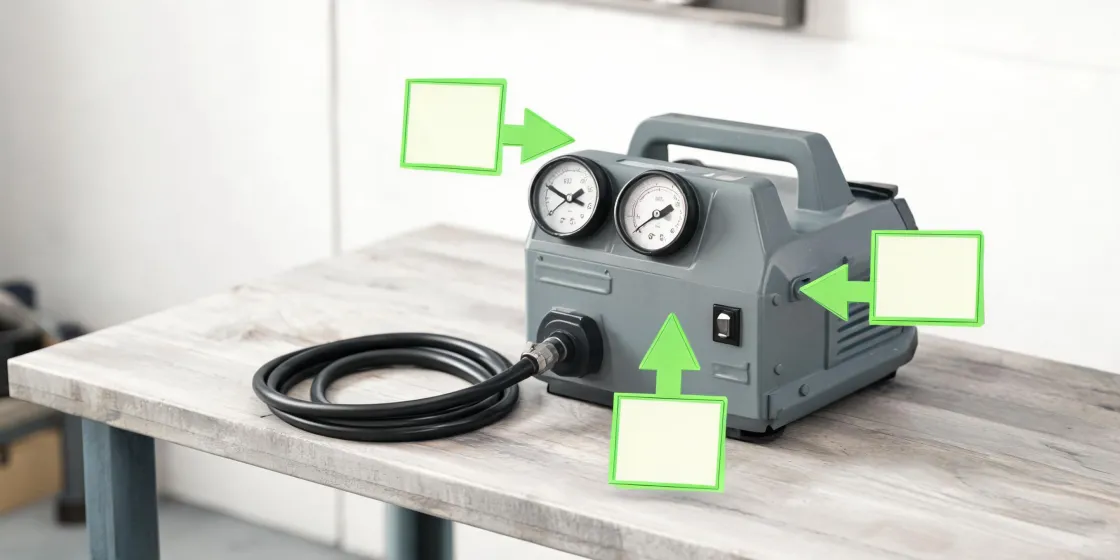
The California Air Tools air compressor CAT-10020C is a 1.5 gallon air compressor in the ultra-quiet family. It's a good match for brad nailers, pin nailers, staplers, and light air ratchet work. The motor is quiet enough to carry into a residence without making everyone stop talking. If you're doing trim, cabinets, or furniture repair, this is the kind of mini air compressor that makes sense.
The California Air Tools CAT-60040CAD is a step up. It's a 6-gallon model, still in the ultra-quiet family, and it gives you more stored air before the pump cycles. That matters when you're using a tool with a slightly higher air demand or when you're running more than one nailer off the same setup. It's still a compact, portable unit, but it buys you more overhead.
What I'd actually tell a contractor is this: buy the smallest compressor that can run your highest-demand tool with at least a 50% duty-cycle margin. If the tool spec says 2.0 CFM at 90 PSI, you don't need a 10-gallon monster. You need a compressor that reliably delivers 2.0 CFM at 90 PSI.
What I check before recommending any mini air compressor
In my quality role, I've learned to look past the big painted numbers. Here's the list I use:
- CFM at 90 PSI. This is the number that tells you whether a nailer will cycle. Ignore 'peak CFM' and focus on continuous CFM at the pressure you use.
- Decibel rating. Quiet means something different to every brand. Check if the dB number is measured at one meter and under load.
- Duty cycle. A pump rated for 25% duty cycle needs to rest. For intermittent nail guns, that's fine. For HVLP sprayers, it's not.
- What's included. A bare compressor without a hose, couplers, and fittings is a lower price only in the same way a phone without a charger is a lower price.
I've learned to ask 'what's NOT included' before 'what's the price.' It's the most useful purchasing question I know. The brand that lists everything upfront—even if the total looks higher—usually costs less in the end.
When my gut disagreed with the spreadsheet
A few years ago I ran a comparison between two configurations of the same compressor line. The data said the lower-flow unit should still run a brad nailer fine. My gut said it wouldn't, because I knew the regulator on that configuration had a history of reading high. I set up both units with a 50-foot hose and a brad nailer, and my gut was right. The lower-flow unit stalled before the nailer seated a 2-inch brad.
That experience shaped how I review products now. Spec sheets are necessary, but they're not sufficient. The real question isn't 'what's the tank size?' It's 'what does the airflow look like at the end of the hose?'
When the answer changes
If you're framing houses or roofing, a cordless framing nailer with spare batteries can be worth the money. You're not dragging a hose up ladders, and the speed is excellent. That's a genuine case where the cordless answer is better.
If you're a trim carpenter running three or four nail guns, replacing all of them with battery versions is expensive. A quiet 1.5 gallon air compressor plus pneumatic tools is often lighter and cheaper than buying a new battery platform.
If you're a homeowner doing one shelf per year, a cordless nail gun for that specific job is probably fine. There's no rule that says every workspace needs an air compressor.
The boundary condition is simple: Match the power source to the whole tool kit, not to one popular question.
The honest bottom line
Does a cordless nail gun need an air compressor? No. It really doesn't. But if you already own pneumatic tools, or if you're starting a shop and want room to grow, a California Air Tools air compressor gives you a second path that's quiet, reliable, and easy to maintain. The CAT-10020C gets you into that path with the smallest footprint. The CAT-60040CAD gives you more reserve if you need it.
Real talk: a cordless nail gun is a fine tool. It's just not the same tool as a pneumatic nailer, and it doesn't have to be. Compare the specs that affect real work—CFM, duty cycle, noise, and total delivered air—and you'll know which side of the battery line you should be on.

Maren Jorgensen
Maren Jorgensen is an independent hand tool and torque applications analyst covering wrenches, pliers, screwdrivers, hammers, sockets, ratchets, hex keys, and tool sets. She applies ISO 6789-1 torque-tool conformance principles while examining jaw capacity, leverage, fastener engagement, torque range, accuracy, handle geometry, and material hardness. Her practical guides help tradespeople and procurement teams select suitable tools, plan controlled tightening, and compare durability without relying on brand reputation alone.