Can I Use Air Tool Oil in My Compressor? A Quality Inspector on California Air Tools 4620AC Parts
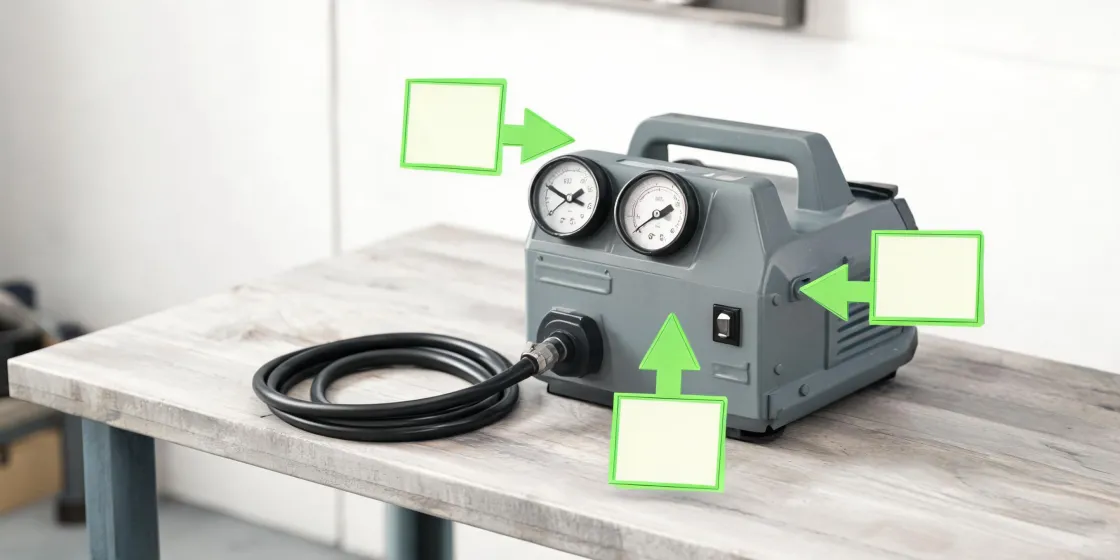
The return label caught my eye because of the orange 'QUARANTINE' sticker. It was on a California Air Tools 4620AC, and someone had scrawled 'valves smell like varnish' on the side of the box. I had just spent an hour measuring a batch of replacement valve plates, and I already had a headache.
I'm the quality and brand compliance manager at an air compressor and pneumatic tool company. I review roughly 250 unique items before they reach customers every year. In 2025, I've rejected about 5% of first deliveries. Most of those rejections are harmless: wrong labels, missing manuals, packaging that looks like it was folded by an impatient ghost. A few are not harmless.
The Question That Started It
The week before that return landed, a customer had asked our support team, 'Can I use air tool oil in my compressor?'
Short answer: no, not in an oil-free pump. At least, that's been my experience with every California Air Tools model we service.
If you own an oil-free California Air Tools compressor, the owner's manual for the 4620AC calls the pump oil-free and does not list oil in the maintenance schedule. There is no crankcase to fill. The pump is designed to run without oil. Air tool oil, on the other hand, is for pneumatic tools: nail guns, air ratchets, and a long barrel air hammer that needs its internal cylinder lightly lubricated. The same bottle that keeps a framing nailer moving is not a compressor maintenance item.
That sounds simple, but simple messages are easy to get wrong under pressure.
The Email That Caused the Return
The support agent meant well. He saw the 4620AC spec sheet, saw 'oil-free,' and reasoned that a few drops of air tool oil in the intake would help the piston move more easily. It's the kind of wrong answer that sounds technical. He replied to the customer: 'Since the pump doesn't need compressor oil, you can add a few drops of air tool oil to the air intake if it helps.'
We didn't have a formal approval chain for oil questions then. I'd flagged the idea two years earlier, but the support team was busy and the oil question is rare enough that I let it go. That third time, the cost was a unit plus a customer relationship.
When we opened the compressor, the intake path was tacky. The oil had carried dust and carbon into the valves. A tiny amount of air tool oil in a compressor pump won't always wreck the machine immediately. It deposits on the valve plates and slowly reduces heat transfer. Then one summer day, the pump sounds different, the motor strains, and the customer blames the brand.
I should add that this particular unit had already seen an aftermarket valve plate. That's the next part of the story.
The Problem With 'Fits' 4620AC Parts
The customer had not bought the original California Air Tools 4620AC parts kit. He had bought a cheaper valve plate on an online auction site, listed as 'fits 4620AC.' It arrived in a generic air compressor accessories box that was close to ours but not exactly ours. The listing said 'genuine equivalent.'
We measured the valve plate. It was 0.003 inches thinner than our specification. I don't want to pretend that's a giant gap. For a mounting bracket, you might ignore it. For a valve plate, it changes the seal timing and the piston clearance. The numbers said it was close. My gut said to test it. The technician who ran the test said, 'It's not gonna hold.'
In a 30-minute no-load run, the discharge temperature got 18 degrees Fahrenheit above our internal limit. That is not an explosion. It is not a dramatic failure. It's the kind of heat that hardens an oil seal, flexes an aluminum head, and turns a 4-year-old compressor into a 6-month-old compressor.
We rejected that batch. If the customer had installed it, he would have paid for the part, the labor, and probably a second repair. At least with our test, it only cost us the part and some electricity.
What the California Air Tools 20020 Price Is Really About
That same week, a distributor asked a question about the California Air Tools 20020 price. He was comparing it to a smaller 4620AC and wondered whether he should save money or make the jump to the 20-gallon tank.
I'm not a sales engineer. I don't set prices, and I don't claim to know every regional discount. I can tell you what's inside the box, because I review units before they leave. With the 20020, you're paying for more than tank volume. You're paying for a heavier-duty pump, a larger motor, and enough reserve air for tools that draw a lot of CFM.
If your job is a long barrel air hammer, for example, the 20020 is a much better match than a portable 4.6-gallon unit. A long barrel air hammer is a greedy tool. It needs volume and pressure. The air tool oil goes into the hammer, not the compressor. But the compressor still has to supply the air.
So the California Air Tools 20020 price is not a number I can quote forever. Dealer pricing changes. Sales promotions change. What I can tell you is to compare total cost, not sticker price. That includes shipping, future parts availability, and whether the spec sheet actually supports your air tools. A savings of 40 dollars disappears if the compressor can't handle your busiest day.
Air Compressor Accessories and Honest Limits
Another thing I've learned: air compressor accessories can either help or hide a problem. A good regulator and filter won't turn an undersized compressor into a shop workhorse, but they will protect a nail gun or air hammer from pressure spikes and moisture. A cheap accessory can look exactly the same from the outside. It doesn't behave the same on the output side.
This is where my professional boundary gets tested. Someone will ask, 'Is the 4620AC enough for my shop?' I can tell you the measured specs, and I can tell you what we found in stress tests. But I can't tell you what your compressed air demand is. That's your call, or a better engineer's call. The supplier who says 'yeah, it'll work' without asking about your tools and duty cycle is overpromising. I'd rather send you to someone who asks questions.
Lessons I Wish I'd Written Down Earlier
I implemented a verification protocol for incoming parts in 2022. It was a simple checklist: thickness, hardness, finish, packaging, paperwork. That protocol caught the aftermarket valve plate. But I hadn't extended the same logic to information going out. That was the actual process gap.
Now, any question that mentions oil, lubricant, or 'can I use this instead?' has to go to a senior tech before it's answered. It's a small rule. It would have prevented the varnish smell on that return.
Oh, and the support agent who gave the wrong answer? He is still with us. He helped rewrite the oil reference sheet. A good process fixes the problem; punishment only makes people hide mistakes. That's not a motivational poster. It's the difference between catching an issue at 8 a.m. and discovering it after the customer opens a return.
So, can I use air tool oil in my compressor? No, not in an oil-free California Air Tools pump. And if you have an oil-lubricated compressor, use the compressor oil specified in the manual. For your long barrel air hammer, use air tool oil. Keep the bottles labelled, keep the aftermarket parts suspicious, and keep the process simple. At least, that's been my experience.

Maren Jorgensen
Maren Jorgensen is an independent hand tool and torque applications analyst covering wrenches, pliers, screwdrivers, hammers, sockets, ratchets, hex keys, and tool sets. She applies ISO 6789-1 torque-tool conformance principles while examining jaw capacity, leverage, fastener engagement, torque range, accuracy, handle geometry, and material hardness. Her practical guides help tradespeople and procurement teams select suitable tools, plan controlled tightening, and compare durability without relying on brand reputation alone.