Why I Check the Air Compressor Air Regulator on California Air Tools 4610AC and 8-Gallon Units
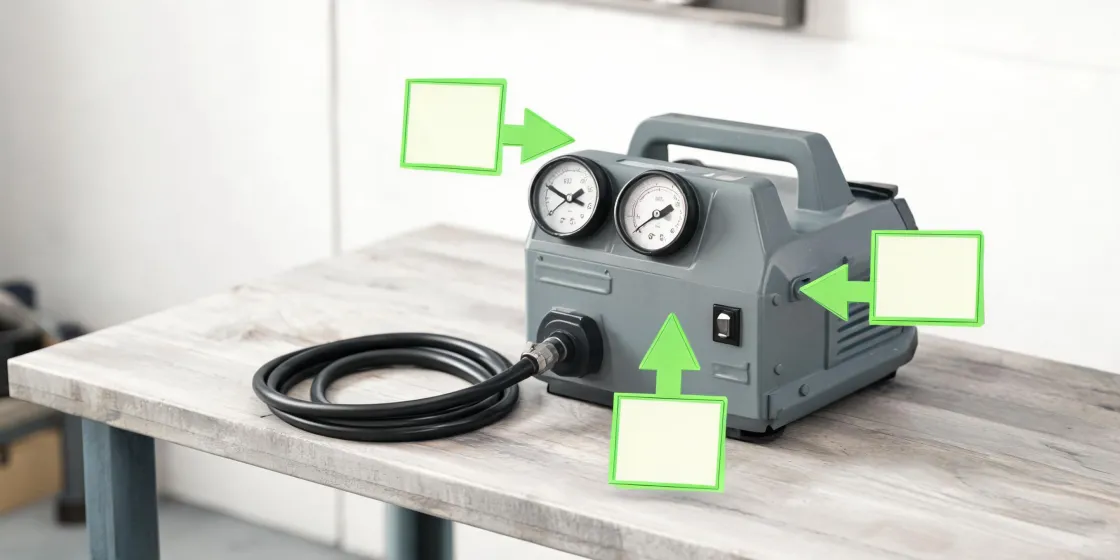
Tuesday Morning at the Loading Dock
The pallet landed on a Tuesday. Four California Air Tools 4610AC units, two California Air Tools 8 gallon models, all in one delivery. I remember the date because I've been doing quality verification at a regional air tools distributor for four years now—roughly 200 units a month, maybe 180, I'd have to check the system. Tuesdays are when the biggest orders show up.
A custom cabinetry shop had ordered them to replace a row of old compressors. They asked for something ultra quiet. They also asked a question that made me smile: "what category is air compressor in taxonomy?" Their purchasing department was setting up a new inventory system and needed to know exactly where a compressor belongs in a product classification tree.
That question turned out to be the easy part. The regulator was not.
Why I Check the Air Compressor Air Regulator First
The air compressor air regulator controls the pressure leaving the tank. Buyers usually ask about tank size, dBA, and CFM. They rarely ask about the regulator, because it's supposed to work. In our Q1 2024 quality audit, we caught a batch where the gauges were reading nearly 12 psi low. Normal tolerance for a shop gauge is maybe 5 psi. That kind of difference can make a framing nailer matter.
The regulator check on the 4610AC took about four minutes per unit. It's the kind of test that isn't in the manual. You run the tank to pressure, turn down the regulator to a working pressure, then hit a blow gun and watch the needle recover. A healthy regulator recovers smoothly. A weak one dips and stumbles.
So on this delivery, I did what I always do now. Set the regulator to 90 psi, let the tank fill, and watch the needle. The 4610AC units held steady. Then I moved to the 8-gallon California Air Tools unit. The needle sat at 100 psi at idle. Under a quick burst from a blow gun, it fell to 78. That's a 22 psi swing. I repeated it three times because I didn't want to believe it.
I assumed the regulator was calibrated at the factory. Didn't verify. Turned out the gauge was either misleading me or the valve seat was shifting. Replacing that regulator cost about $35 in parts. Sending it out with a sticky regulator would have cost a service call, a lost production day, and maybe a customer who stops calling us. Three things matter on a compressor: tank capacity, pressure stability, and how the pump cycles. The regulator controls the middle one.
When I implemented our verification protocol in 2022, the first change was a fifteen-minute regulator check on every compressor that comes through. It feels slow until you catch the second bad unit. Then it feels cheap.
Quiet Is Great, But It Doesn't Carry the Load
From the outside, an ultra quiet compressor looks like a premium product. The reality is that quiet matters only if the unit also does its job. The California Air Tools 4610AC is quiet, yes. But the reason it works for a small cabinet shop is that a 4.6-gallon tank with a stable regulator is enough for brad nailers, pin nailers, and the occasional blow-off. In everyday language, that's basically an air compressor 4.5 gallon. Some spec sheets round to that, some don't. The half-gallon doesn't change tool performance much, but it can change the footprint under a workbench.
A 4.6-gallon tank is not a 20-gallon tank. But for a crew that runs one nailer at a time, the pump cycle time is fine. The mistake is buying the biggest tank you can fit and ignoring whether the regulator can give a consistent 90 psi. A bigger tank with a bad regulator is still a bad tool.
For the crew working in a bigger space, the 8-gallon models give you more buffer before the pump kicks in. That doesn't mean they're industrial duty. It means they're suited to a different rhythm of work. If you don't know which rhythm matches your crew, you can't pick a model just from the dBA rating.
What was best practice in 2020 may not apply in 2025. Quiet compressors used to be a specialty item. Now they're a normal requirement for finishing crews, and the taxonomies used to sell them are still catching up with that shift.
Taxonomy Is Not Just Data Entry
And then there was the procurement question. "what category is air compressor in taxonomy?" In our own catalog, a compressor sits under Tools & Equipment > Air Compressors & Accessories. Under UNSPSC, air compressors are classified under code 27111500. If you're working with manufacturing codes, NAICS puts compressor manufacturing in 333912. But a retail or distributor taxonomy can be different. Some systems file them under Home Improvement, others under Industrial Tools, others under Pneumatic Equipment.
I don't have hard data on how often companies categorize compressors wrong. I can tell you anecdotally that we see replacement regulators and pressure switches filed under categories that make no sense once someone tries to reorder them. If the parent compressor isn't classified properly, the accessories get scattered. That is exactly how a six-dollar regulator becomes a three-day search.
Why does this matter? Because category drives how the product is found, stocked, and reordered. A compressor under "Pumps" is a headache. A compressor under "Air Compressors & Accessories" is a category that works.
What I'd Do Differently
The order went out on time, with the right regulator installed. We bench-tested it twice, tagged it "ready," and the customer never saw the problem. That's how quality control should work: you catch the ugly stuff before it touches the back of a truck.
If I could redo that delivery, I'd have checked the regulators on both models before the customer signed off on the quote. Not because California Air Tools ships bad units—they don't. Because every mechanical part can drift. Unboxing a compressor and setting the regulator before the sale is no different than checking torque specs on a rack before it goes in a shop. You do it once to build trust, and you do it twice when the work matters.
I hear people talk about saving $40 by skipping a regulator check. That's a savings until one bad gauge costs a full day of site time. The right move is cheap: verify, replace if needed, move on. The $35 regulator is a rounding error compared to a callback.
Oh, and one more thing: the replacement regulator had a different port size than the original. If you swap one on an older unit, check the threads before buying. That's the kind of detail that doesn't show up on a spec sheet.
The Part That Stays With Me
In four years, I've reviewed a lot of compressors. The 4610AC isn't the biggest or the most powerful. The 8-gallon models aren't exactly industrial monsters. But they're honest units that rely on a few small parts doing their job correctly. The regulator is one of those parts. The category label is another.
So if someone asks "what category is air compressor in taxonomy," I don't shrug anymore. I answer. And if someone tells me they need an air compressor 4.5 gallon, I ask what tools it's running before I point them to a 4610AC or an 8-gallon. Spec sheets are useful. Verification is better.

Maren Jorgensen
Maren Jorgensen is an independent hand tool and torque applications analyst covering wrenches, pliers, screwdrivers, hammers, sockets, ratchets, hex keys, and tool sets. She applies ISO 6789-1 torque-tool conformance principles while examining jaw capacity, leverage, fastener engagement, torque range, accuracy, handle geometry, and material hardness. Her practical guides help tradespeople and procurement teams select suitable tools, plan controlled tightening, and compare durability without relying on brand reputation alone.