What Is Air Compressor Duty Cycle? The 6 AM Lesson That Saved a Hotel Renovation
Thursday, March 21, 2024. 4:58 PM. I had my keys in my hand when the phone rang.
A project manager named Dan got right to it: "I need an air compressor on site by 6 AM tomorrow. It has to be quiet. And I need a way to spray a clear coat on fourteen doors by Friday."
His crew had watched a rental compressor die the day before, and the rental company couldn't bring a replacement until Monday. The crew was scheduled to start trim work at 7 AM. The second floor of the hotel was still occupied. And the contract's late-delivery penalties added up to roughly $12,000 if the rooms weren't ready for Friday check-in.
In my role coordinating rush equipment and emergency deliveries for commercial shops, I've handled this kind of 5 PM call for eight years—over 200 emergency requests per year across our customers. You'd think it gets routine. It does not. And this one, I almost got wrong.
The 4:58 Call That Started It
Normal turnaround for a request like this would be two or three days. We had about 12 hours. The two problems were: a compressor quiet enough to run near occupied rooms, and a spray setup for the doors. We had both in the shop that night.
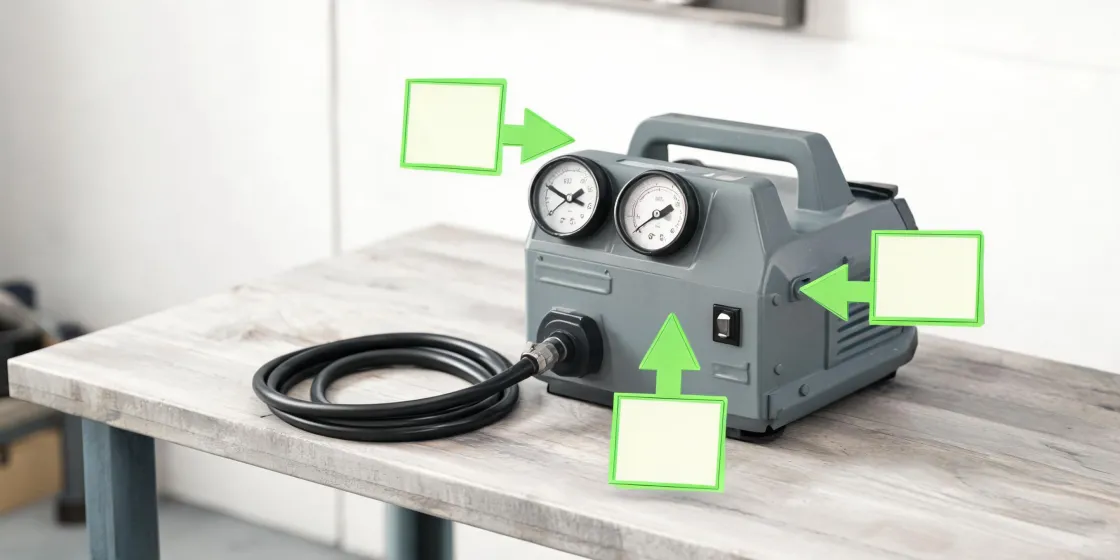
A California Air Tools 8010DSPC — 8-gallon tank, roughly 56 dB, our go-to for noise-sensitive sites. And a California Air Tools 4620AC — a 20-gallon air compressor with more flow, more tank, and more weight. Also noticeably louder.
I made the call in about thirty seconds. The 8010DSPC was the obvious choice for a hotel. It's the unit we bring when noise matters most, it's built for contractors, and I'd watched it run nail guns on trim jobs plenty of times without complaint. So I told the crew to load the 8010DSPC, a couple of 100-ft hoses, and a California Air Tools 5 gallon pressure pot — because the client's spray rig had failed, and the pressure pot is the kind of tool that isn't glamorous until it saves the entire job.
What I Assumed — And Did Not Verify
Here's the part I don't love telling. I assumed that "quiet" and "contractor-grade" also meant "enough duty cycle for two guys running nail guns back-to-back all morning." I did not verify that against the tool list Dan sent at 6:12 AM, because by then the truck was already on the road.
To be fair, the 8010DSPC is a genuinely well-built machine. It has a strong pump for its class, and it's quiet in a way that makes a hotel manager nod and relax. But it's also an 8-gallon unit. It's designed for work where you're moving between tasks — not standing in one room pulling the trigger for three straight hours.
Quiet is a decibel rating. Duty cycle is a work rating. I confused the two.
What Is Air Compressor Duty Cycle?
Let's pause the story here, because this is the spec that bit me.
Duty cycle is the percentage of time a compressor can run under load within a standard time window before it needs to cool down. A unit rated for a 25% duty cycle in a 10-minute cycle can run for about 2.5 minutes, then has to rest for 7.5 minutes. Push past that for too long, and thermal overload protection shuts the motor down — on purpose, before it burns itself up.
Some units are rated for continuous duty: 100% run capability. Others are rated for intermittent work, which is fine if the work is actually intermittent. The trouble starts when "intermittent" becomes "constant."
At 11:20, the 8010DSPC stopped. Not a dramatic noise. Just silence, which in a hotel is the loudest sound there is.
11:20 AM — The Machine Was Right, I Was Wrong
The tank gauge was falling. The motor was hot. I checked the obvious things anyway. Hose pinched? No. Filter dirty? No. Outlet blocked? No.
The compressor wasn't broken. It was doing exactly what it was designed to do: stop before it destroyed its own pump. Two pneumatic nail guns, two guys, one 8-gallon tank, and a nearly continuous run cycle. The duty cycle math was not on our side.
The hotel manager appeared at the end of the hallway. Dan looked at the clock. Nobody said the word "penalty," but it was in the air.
The 20-Gallon Air Compressor Rescue
I called the shop and told them to bring the 4620AC. I should have sent it at 6 AM. At 11:20, I paid for the decision, and the currency was embarrassment.
The 20-gallon air compressor arrived at 12:30 after a 45-minute drive. We placed it in a service hallway two corners away from the nearest occupied room, ran 100 feet of hose, and checked the noise level on a phone app: 58 dB at the occupied end. Acceptable.
The difference was immediate. The 20-gallon tank holds more than double the air, and the pump recovers fast enough that the unit ran almost uninterrupted all afternoon without tripping once. The crew finished trim work in all twelve rooms by 4 PM.
Meanwhile, we set up the pressure pot for the doors. The California Air Tools 5 gallon pressure pot turned a dead-sprayer crisis into a 20-minute setup: connect the air hose, fill the pot, adjust the regulator, test the spray pattern on a scrap piece, coat the door. Fourteen doors, three batches, no drama.
Honestly, I'm not 100% sure why the regulator seated stiff at first. My best guess is a cold o-ring after a night in the truck. We swapped in a spare, and it seated fine. The whole detour cost us ten minutes, which felt like a luxury by that point.
The Call About T30 Air Compressor Parts
Two weeks later, Dan called about the compressor in their other shop — an aging T30-style workhorse that had been run hard by three different owners. He needed a valve kit and gasket set. He knew we carry parts for our own compressors, so he assumed we'd have T30 air compressor parts too.
If you're searching for t30 air compressor parts right now, this next part is for you.
We don't carry them. That's not what we do. Our parts line covers California Air Tools compressors and the pneumatic accessories we sell — not universal legacy pump parts. I told Dan that directly, then gave him the names of two specialists who rebuild T30s for a living.
It felt counterintuitive to say no. But I've never fully understood why some vendors pretend to be a one-stop shop for everything. The vendor who says "this isn't our strength — here's who does it better" earns trust for everything else they say. A month later, Dan ordered a portable California Air Tools compressor for a different site, from us, without asking for a single competing quote.
Duty Cycle Lessons From a 12-Hour Fire Drill
We finished at 7:10 PM. Rooms passed the pre-check the next morning. No noise complaints. No penalty. The job got done — but "done" was a team effort, not a perfect plan.
Looking back, I should have sent both compressors at 6 AM. At the time, I was trying to save Dan a second same-day delivery fee. That was a $50 decision that almost cost a $12,000 day.
If I could redo that one call, I would. Since I can't, here are the lessons I now give every new person in our shop:
- Learn duty cycle before you need it. Check the compressor's duty cycle rating, then check the CFM your tools actually demand at the pressure you run them. If you don't know the numbers, don't guess — look them up.
- Match the tank to the job. An 8-gallon unit like the 8010DSPC is fantastic for trim work, mobile jobs, and light assembly. If you're gonna run multiple guns continuously, bring a 20-gallon air compressor with the recovery rate to back it up.
- Quiet is not a synonym for heavy-duty. Ultra-quiet matters in a hotel, a hospital, a school. But the decibel rating tells you about noise, not about how long the unit can run. Those are two totally different specs.
- Say what you don't do, and say who does it. An honest "no" is the fastest way to make your next "yes" worth something.
So, what is air compressor duty cycle? It's the spec that decides whether your compressor is your teammate at 11:20 AM or your excuse at 11:20 AM. Standing in that hotel hallway, I learned the difference the hard way — and I'm glad the only thing hurt was my pride.
Price reference: As of January 2025, the 8010DSPC lists roughly in the $350–$450 range, and California Air Tools 20-gallon models in the $750–$950 range, at major U.S. online retailers. Pricing is for general reference only; verify current rates before ordering.

Maren Jorgensen
Maren Jorgensen is an independent hand tool and torque applications analyst covering wrenches, pliers, screwdrivers, hammers, sockets, ratchets, hex keys, and tool sets. She applies ISO 6789-1 torque-tool conformance principles while examining jaw capacity, leverage, fastener engagement, torque range, accuracy, handle geometry, and material hardness. Her practical guides help tradespeople and procurement teams select suitable tools, plan controlled tightening, and compare durability without relying on brand reputation alone.