The 4620AC That Almost Got Returned: A Quality Inspector's Take on Air vs. Battery, Tank Size, and the 8010A
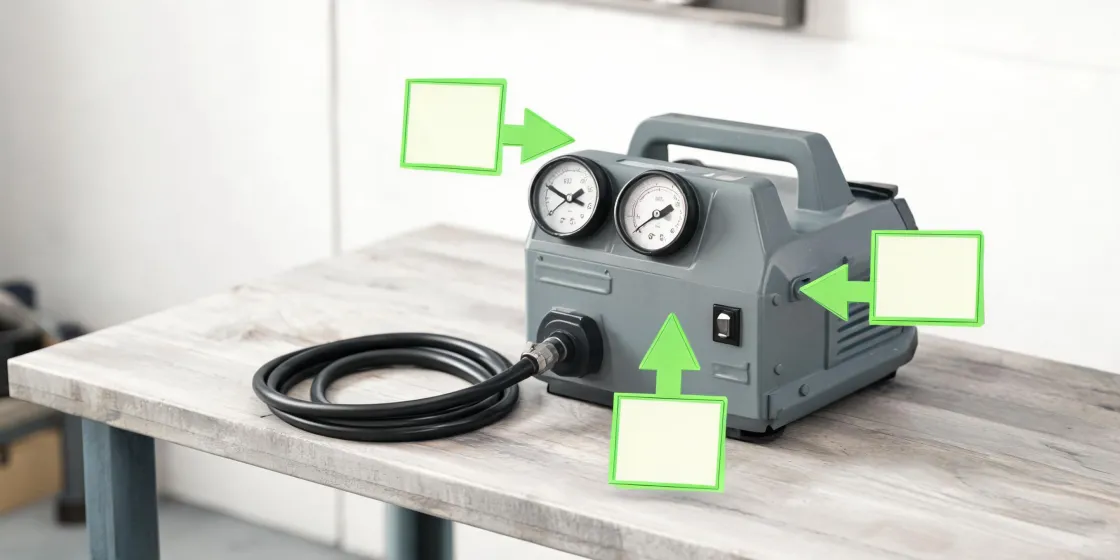
Let me start with the subject line that ended up in my inbox on a Tuesday morning: "RETURNING COMPRESSOR—DONE WITH IT."
The Email That Started It
At 7:40 AM, our air compressor tech support line forwarded me an RMA request from a contractor in Fresno. He bought a California Air Tools 4620AC six months earlier. His complaint was straightforward: the tank lost pressure every night, the compressor cycled all day, and he was one click away from ordering a battery-powered impact wrench kit and giving up on air tools entirely.
I'm the quality and brand compliance manager for an authorized California Air Tools distributor. In plain terms: I inspect every unit before it ships, every unit that comes back, and every warranty claim that crosses our service counter. Last year I reviewed about 200 units across all models. In Q2 2024 alone, I rejected 11% of first deliveries from the factory for things like a dented tank, a misaligned pulley, or a missing manual.
The email bothered me, but not because the customer was angry. The 4620AC is one of the most reliable models we stock. Returns on it are rare. So before I approved the RMA, I did something a lot of support staff forget to do: I asked for proof.
My First Misdiagnosis (on a Different Unit)
That "ask for proof" habit didn't come naturally. In my first year, I made the classic support mistake: I took a return description at face value. A customer said his California Air Tools 8010A had a broken pressure switch. I checked the box, approved the RMA, and did not open the unit until it reached the service bay.
It wasn't the pressure switch. He had the compressor plugged into a 75-foot extension cord made from 16-gauge wire. The motor couldn't get enough voltage, so it clicked, cycled, and eventually failed to start. The pressure switch was doing its job. The customer's wiring was not. That mistake cost us a $120 diagnostic fee, a free replacement switch, and a customer who almost switched brands over something I could have caught with a two-minute phone call.
So this time, I asked for photos and a video of the gauge overnight. The contractor sent me a 20-second clip. The needle dropped from 120 psi to 96 psi in nine minutes with the pump off. That's a real leak.
What Actually Caused the Leak
We scheduled a pickup and rolled the 4620AC into our shop. I pulled the belt guard, checked the check valve, inspected the tank welds, and sprayed every joint with soapy water. The tank deadheaded—meaning it held static pressure. Then I moved to the outlet side and found the leak in about two minutes: a quick-connect coupler with a cracked O-ring.
From the outside, it looks like a compressor failure when a tank drains overnight. The reality is the compressor was fine. The coupler between the compressor and the hose was the thief. That part costs about $10. The customer was about to spend $500 on a new battery wrench to solve a $10 plumbing problem. (He was not thrilled, but he did laugh about it.)
If you ever call air compressor tech support with a pressure-loss problem, start with the cheapest parts first. Couplers, fittings, and hoses fail far more often than tanks, pumps, or check valves.
Then Came the Air vs. Battery Question
After the diagnosis, the contractor calmed down. Then he asked a question I hear almost weekly: "Which is better—air or battery impact wrench? I've been reading forums all night, and everyone has a different answer."
I sell air compressors. The honest answer is not always in my favor. The upside of telling him the truth is that he'll trust me on the next purchase. The risk is that he decides to go all-battery and never needs a compressor from us again. I kept asking myself: is the honest answer worth losing the sale? In the end, I decided it was.
Where Battery Impact Wrenches Make Sense
If you use an impact wrench occasionally—tire rotations, light repairs, a Saturday suspension job—battery tools are a legitimate choice. No hoses, no regulator settings, no compressed-air maintenance. You pick it up and go. For intermittent use, the simplicity is worth a lot.
Where Air Still Wins for All-Day Work
For a crew relying on impact wrenches through a full workday, air still has clear advantages:
- Weight-to-power ratio. An air impact wrench is generally lighter than a battery model with similar torque, and that matters after hour five.
- Consistent performance. Air torque stays steady as long as the regulator holds. Battery output sags as the pack drains.
- Lower total repair cost. A rebuild kit for an air impact wrench is often under $15. Replacing a battery pack is a much bigger line item.
There's also the battery ecosystem problem. Most crews don't stop at one wrench. They need batteries, chargers, and backup units, and that cost adds up fast. If you already have a 120-volt circuit and a quiet compressor, converting an entire shop to battery because of one cracked O-ring is a hard financial case to justify.
The 28-Gallon Air Compressor Fallacy
The contractor had one more thought: "Should I just upgrade to a 28-gallon air compressor instead? Wouldn't a bigger tank fix the cycling?"
This is one of the most common misconceptions we see. A larger tank stores more air; it doesn't create more air. If your pump moves 5.0 CFM at 90 psi and your tool needs 4.0, the bigger tank lets you work longer before the pump refires. But a bigger tank does not turn a 5.0 CFM pump into a 7.5 CFM pump. If your tool requires more than the pump delivers, the bigger tank just delays the moment of truth.
We've had customers buy a 28-gallon tank, connect it with a restrictive 1/4-inch ball valve, and then blame the compressor for low tool performance. The compressor was fine. The fitting between the tank and the tool was strangling the air. Tank size is only part of the equation.
For the contractor's situation, a 28-gallon unit would have given him more reserve, but it wouldn't have stopped the leak at the coupler. Fix the leak, and the original compressor's tank was still adequate for his framing nailer and air ratchet.
The California Air Tools 4620AC Price Question
When customers ask about the California Air Tools 4620AC price, I tell them to look at more than the sticker. As of January 2025, the 4620AC usually sells for roughly $500–$600 at major U.S. online retailers (verify current pricing, since freight costs have made prices jump around). That's more than a no-name compressor with the same tank size. But the total cost picture includes:
- Noise: the 4620AC is genuinely quiet enough for indoor shop use, meaning it can run through a homeowner's garage or a small workshop without everyone reaching for earplugs.
- Pump maintenance: it uses an oil-free pump, which removes oil-change chores from the routine.
- Parts availability: because California Air Tools is a recognized brand, replacement parts (belts, filters, rebuild kits) are easy to source.
Is it the cheapest option? No. Is it the least expensive option over a few years of real use? Usually, yes.
What About the 8010A?
If the 4620AC is more than you think you need, the 8010A is the California Air Tools model we recommend most for lighter work. It's smaller, lighter, and easier to move around. For interior trim, finish nailers, brad nailers, and occasional air ratchet work, it's a solid fit. People often ask for a California Air Tools 8010A review before buying one; the short version is that it's an excellent machine if you respect its output limits. It is not built for extended framing work or continuous sanding. The customers who return 8010As are usually the ones who tried to stretch it beyond its CFM rating. The unit did what it was supposed to do; the expectation was wrong.
What I'd Do Differently
Looking back, I should have asked for a photo of the fittings before I approved the RMA. At the time, I was juggling a support queue and a pile of inspection forms, so I defaulted to the standard process. If I could redo that decision, I'd ask for a picture of the couplers, hoses, and pressure switch on every pressure-loss claim. It would have saved this contractor four days of downtime and a lot of frustration.
I also should have raised the air vs. battery comparison myself. It's a question every shop owner asks at some point, and pretending the answer is always "air" is a good way to lose credibility.
The Bottom Line
If you're deciding between air and battery impact wrenches, don't make the call based on one bad afternoon with a leaky coupler. Look at your weekly workload, your repair budget, and the total cost of the system you'd be buying into. If you already own a California Air Tools compressor that's losing pressure, check the cheap stuff first. The O-ring on a coupler costs less than a tank of gas in a pickup truck.
We're not the right fit for every customer. If you're running an industrial production line that needs 30 CFM at 175 psi, you should be talking to a commercial compressor dealer. But for a contractor, a small workshop, or a repair shop that needs steady, quiet air, the 4620AC is a solid choice—especially when you buy it based on the real specs, not a marketing photo.
"A compressor is only as useful as the pump's steady output at the pressure you actually need. Tank size fills in the gaps, but it can't replace CFM."
Pricing as of January 2025; verify current rates with your retailer. Specs are based on the owner's manual and our in-shop measurements; your results may vary.

Maren Jorgensen
Maren Jorgensen is an independent hand tool and torque applications analyst covering wrenches, pliers, screwdrivers, hammers, sockets, ratchets, hex keys, and tool sets. She applies ISO 6789-1 torque-tool conformance principles while examining jaw capacity, leverage, fastener engagement, torque range, accuracy, handle geometry, and material hardness. Her practical guides help tradespeople and procurement teams select suitable tools, plan controlled tightening, and compare durability without relying on brand reputation alone.