Our Compressor Died 36 Hours Before Trim Day — a California Air Tools 20040DC Rescue Story
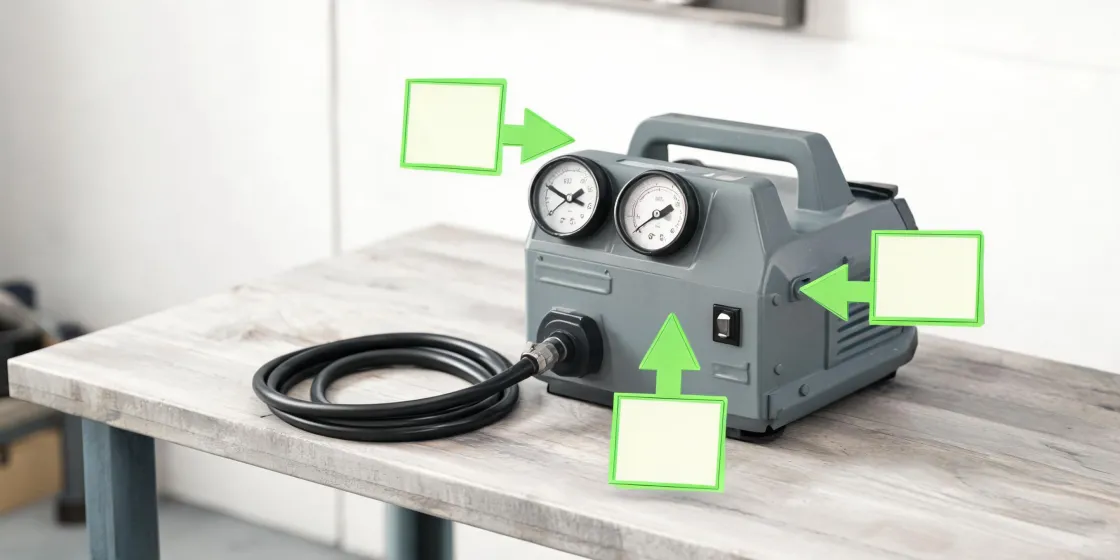
It was 2:30 on a Tuesday afternoon when our shop manager called. The crew was already on site, prepping for a full interior trim package with a Thursday deadline. And the compressor — the old workhorse that had been with us for six years — had just seized up.
Not a slow leak. Not a belt that needed tightening. Seized. Dead. Smoke and all.
Here's the situation: trim day was in 36 hours. Our contract carried a $50,000 penalty clause for missing the date. And every store within 50 miles had exactly two options available for immediate pickup — a pancake compressor that sounded like a jackhammer, or a 60-gallon monster that wouldn't fit in the van.
The site had noise restrictions, too. Quiet hours from 8 AM to 5 PM, every weekday. The whole day. So whatever we bought had to run quiet enough for a commercial building during business hours — not "quiet for a compressor" quiet, but actually quiet.
Fun problem, right?
The Search: More Options Than I Knew Existed
The last time I bought a compressor, quiet wasn't part of the conversation. You picked between loud and really loud. If the motor kicked in, you accepted that you couldn't hear the radio for the next few minutes.
That was years ago. The industry's changed a lot since then. What was best practice in 2019 may not apply in 2025 — and when it comes to job-site air compressors, it pretty clearly doesn't. The quiet compressor category used to be a niche compromise. Now it's a legitimate spec you can build a whole fleet around.
A shop owner I trust pointed me to California Air Tools. I knew the name, but didn't know much beyond it. So from the van, with the clock running, I started digging into their lineup.
The Models That Made the Shortlist
Three California Air Tools models kept coming up:
- California Air Tools 1P1060S air compressor — 1 gallon, 1.0 HP, rated around 56 dB. This one's a trim carpenter's sidekick: small enough to grab one-handed, quiet enough to run mid-conversation, and it handles a brad nailer or pin nailer for intermittent work without complaint.
- TS4N5 air compressor — 4 gallons, twin tanks, 1.0 HP. The middle child. More reserve than the little units, still compact enough to toss in a van. It deals with two trim guys running nailers at a moderate pace.
- California Air Tools 20040DC — 20 gallons, 2.0 HP, dual-cylinder pump. Supposedly around 70 dB. And it pushes about 4.0 CFM at 90 psi, which means it can run continuous trim work, staplers, an air ratchet — even some framing nailers — without you sitting around waiting for the tank to refill.
Now, the question I see everywhere from guys in my position: is a 3 gallon air compressor good for nail gun work? And the related one: do I need a 6 gallon 150 psi compressor instead?
Is a 3-Gallon Compressor Enough for a Nail Gun?
Short answer: for most trim work, yes.
Longer answer: it depends on what "nail gun work" means to you.
A brad nailer or pin nailer doesn't gulp air. You're driving a 1-1/4" nail into a casing, not sinking 3" structural nails into engineered lumber. A 3-gallon tank at 120-150 psi gives you enough reserve for 15-30 shots before the motor kicks in. For trim work, where you're firing a few nails, repositioning, measuring — that cycle works fine.
From the outside, it looks like you just need enough air to shoot nails. The reality is more subtle: the tank size question is a recovery-time question, not a "will it work" question. If you're solo, doing trim one piece at a time, a 3-gallon unit recovers fast enough. If you've got two guys hammering wide-crown staples into sheathing nonstop, that same tank is going to leave you waiting.
That's where the 6 gallon 150 psi class earns its keep. Bigger tank, higher headroom, often dual couplings so two people can pull air at once. It's not a huge price step up from the 3-gallon models, and it removes the weak link in a two-person workflow. For a trim crew specifically? I'd call that the sweet spot.
People assume bigger is always better. What they don't see is the trade-off: bigger tanks mean heavier units, longer fill times, and more space in an already crowded van. For a solo finish carpenter, hauling a 20-gallon tank to every job is overkill. For my situation, though — a mixed-use shop van that runs trim, air ratchets, and pressure pots — it made more sense than I expected.
My Actual Decision: The 20040DC
So which one did I buy? I went bigger than my initial plan.
The deciding factor wasn't just Thursday's trim job. It was the rest of the year. We run air ratchets for suspension work in the shop. We use pressure pots for fluid handling on some commercial jobs. The 20040DC covers all of that — plus future site jobs where I don't want to carry a small unit and a big unit and swap between them.
The upside was one compressor doing everything. The risk was hauling a 90-pound unit around when a 4-gallon would've done the job for a week of light trim. I kept asking myself: is the extra capacity worth the extra weight and space?
For me, it was. But the math would look different for a one-person operation doing mostly trim.
Here's what surprised me: it's genuinely quiet. We measured it on site with a meter — 72 dB at ten feet. That's dishwasher territory. The building manager was impressed. The client was impressed. I was mostly relieved I didn't have to negotiate an exception to the noise rules.
How the Job Went
Thursday morning, we ran hoses up to the third floor. The 20040DC hummed along in the hallway all day. Nobody complained. The trim crew hit every milestone. The job passed inspection on Friday, and the penalty clause stayed tucked away where it belonged.
The real confirmation came over the following weeks. We used that compressor for a shop rebuild, a pressure-pot finishing job, and a whole-house trim package. It hasn't stumbled once. That's the difference between buying a quiet toy and buying real equipment from a company that's been doing this for a while.
What I'd Tell Someone in the Same Spot
If you're trying to figure out what size compressor you need for nail gun work, here's what I'd pass along:
- Tank size follows workflow. A 3-gallon compressor can absolutely run a brad nailer. It just can't sustain nonstop production nailing. Figure out your pace first, then pick the tank.
- Quiet is a real spec now, not a marketing gimmick. Noise rules are common on commercial sites, and 70 dB is nothing like the 85-90 dB units from a decade ago. It changes how and where you can work.
- Buy for the next three years, not the next three days. The 36-hour deadline pushed me to a quick decision, but I deliberately chose a model that fits jobs beyond the one in front of me.
- Your old assumptions are probably outdated. If you think "quiet compressor" means weak, or that you need a 20-gallon tank just to fire finish nails, you're working from old information. The fundamentals — CFM, tank capacity, duty cycle — haven't changed. The execution has. A lot.
And honestly? I'm still not sure why the old compressor seized. My best guess is the summer heat pushed an already-old motor past its limit. I've never fully understood why some compressors die without warning while others soldier on for a decade. If anyone's got insight on that, I'd genuinely like to hear it.
Prices for these models vary depending on the vendor and current deals — I'd check california-air-tools.com directly for updated specs and pricing. The fundamentals I described should hold, but verify the numbers against your own needs (source: California Air Tools product documentation, January 2025).
Whichever model you land on, match the compressor to the job, respect the noise rules, and have a backup plan for the day the old unit gives up on you. Because it will give up eventually.
Better to find that out on your terms.

Maren Jorgensen
Maren Jorgensen is an independent hand tool and torque applications analyst covering wrenches, pliers, screwdrivers, hammers, sockets, ratchets, hex keys, and tool sets. She applies ISO 6789-1 torque-tool conformance principles while examining jaw capacity, leverage, fastener engagement, torque range, accuracy, handle geometry, and material hardness. Her practical guides help tradespeople and procurement teams select suitable tools, plan controlled tightening, and compare durability without relying on brand reputation alone.