California Air Tools Buying Guide: Scenario-Based Picks for Shops, Offices, and Maintenance Teams
I am an office administrator for a 140-person company. I manage all MRO and shop supply ordering—roughly $180,000 annually across 14 vendors. I report to both operations and finance. When I took over purchasing in 2020, I assumed the biggest tank and lowest price would solve most air compressor problems. Two return shipments and one very unhappy maintenance lead later, I realized that CFM, duty cycle, and parts support matter more than tank size alone.
So if you are asking which California Air Tools compressor to buy—or whether to repair one—there is no single answer. The right choice depends on how you use air, how long you run it, and what happens when a regulator fails. Here are the scenarios I see most often.
Scenario A: Occasional Use in an Office or Small Shop
This is the trim work, small repairs, and light inflation crowd. You might run a brad nailer for a cabinet project, use an air ratchet for a few bolts, or keep a compressor in a shared maintenance closet. The compressor sits idle most days.
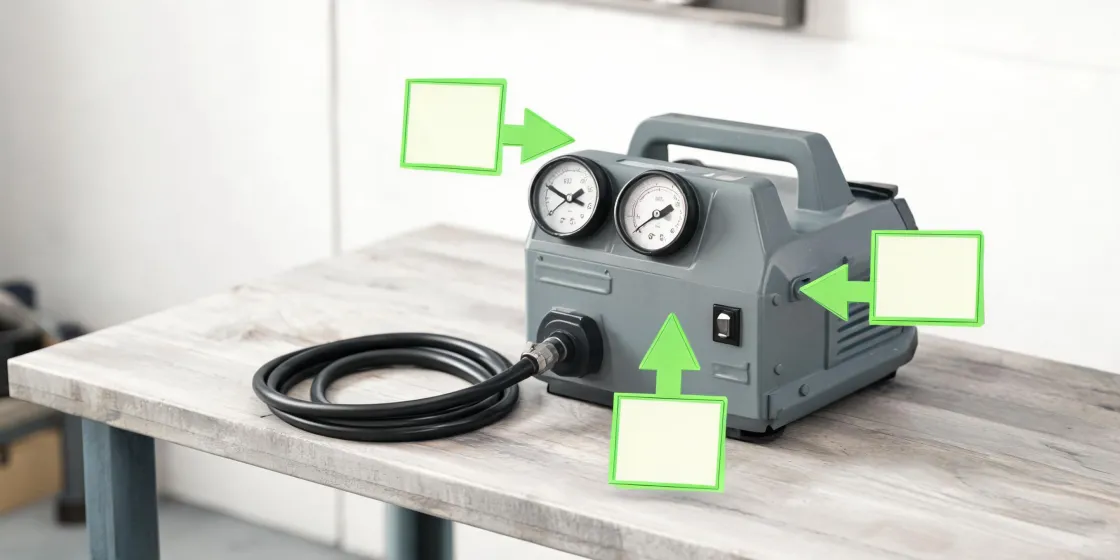
For this, the California Air Tools 10020 is often a strong fit. It is portable, runs on standard 120V power, and it is ultra-quiet enough that people in the next room do not lose their minds. But here is the trap: do not buy it expecting to run a DA sander or a cut-off tool all afternoon. The 10020 is built for short bursts. Check the manual for the exact duty cycle, but many compact units in this class are not rated for continuous run.
If your air compressor regulator replacement is the only issue, a 10020 can be worth fixing. Find the model and serial number, order the correct regulator, and use PTFE tape or paste on the threads. If the tank is rusted or the motor is failing, though, replacement is usually the smarter call.
Scenario B: Growing Shop with Real Air Tools
Now you are running nail guns, staplers, impact wrenches, and air ratchets across a team. The compressor cycles often. You might not run it eight hours straight, but you need it to recover fast enough that work does not stop.
This is where the California Air Tools FBA_15020C and larger units like the California Air Tools Model 2545—often searched as air compressor model 2545—come into play. The FBA_15020C gives you more tank volume and more CFM than a small portable. The Model 2545 sits further up the line for buyers who need more output. I went back and forth between the 10020 and the 15020C for two weeks. The 10020 was cheaper and easier to move. The 15020C had the tank and recovery I actually needed. I chose the 10020 first—and later added a larger unit because I underestimated demand. That was a $400 lesson in buying for the job you have, not the job you wish you had.
This scenario is also where duty cycle becomes a deal-breaker. What is air compressor duty cycle? It is the percentage of time a compressor can run within a given period—often 10 minutes or an hour—without overheating. A 50% duty cycle might mean 5 minutes running, 5 minutes resting in a 10-minute window. A 100% duty cycle means continuous operation. If your tools need more air than the compressor can recover, the unit runs nonstop, overheats, and wears out early. That is not a brand problem; it is a sizing problem.
Per FTC advertising guidelines (ftc.gov), performance claims like duty cycle ratings should be truthful and substantiated. When a spec sheet says 50% duty cycle, that is not decorative—it is the manufacturer stated operating limit.
Scenario C: Production or Industrial Continuous Use
Here is the honest limitation: if you need air for two or three shifts, run multiple tools simultaneously, or require 100% duty cycle, California Air Tools may not be the right fit. That is not a knock on the brand. It is a spec mismatch.
Production environments usually need higher CFM, larger tanks, and industrial-duty motors. You may be looking at two-stage or rotary screw compressors. A portable ultra-quiet unit built for intermittent use will fail under continuous load, even if it is a well-made machine. If you are in this scenario, do not force a square peg into a round hole. Buy the industrial unit, or keep a California Air Tools unit as a backup for light tasks.
Scenario D: Repair vs. Replace a Regulator
Air compressor regulator replacement is one of the most common fixes I approve. The regulator controls output pressure, and when it creeps, leaks, or stops adjusting, your tools either run weak or get blasted with too much pressure.
Before you replace the whole compressor, check three things: the tank condition, the motor, and parts availability. If the tank is solid and the motor runs well, a new regulator is a no-brainer. If the tank is rusted inside or the motor is drawing high amps, replacement is the better financial decision. For California Air Tools units, OEM and compatible regulators are available. Just match the pressure range, port size, and thread type. If you are not sure, take a photo of the old regulator and the model plate before ordering.
How to Tell Which Scenario You Are In
Ask these questions before you buy or repair:
- How many hours per day does the compressor actually run? Two hours is different from eight.
- What is the CFM at 90 PSI for your highest-demand tool? Add 20-30% for recovery.
- What duty cycle does the manual list? If you cannot find it, call the manufacturer.
- Is noise a problem? Ultra-quiet matters in shared spaces.
- Can you get parts in 2025? A cheap unit with no regulator available is not cheap.
If you are an office or light shop buyer, the California Air Tools 10020 is probably enough. If you run real air tools daily, look at the FBA_15020C or air compressor model 2545 and confirm the duty cycle. If you need continuous industrial air, look elsewhere—honestly. And if the only problem is a failed regulator, fix it and keep the compressor running.
Bottom line: match the compressor to the workload. Do that, and you will avoid the return shipments, the overheating, and the awkward conversation with your maintenance lead.

Maren Jorgensen
Maren Jorgensen is an independent hand tool and torque applications analyst covering wrenches, pliers, screwdrivers, hammers, sockets, ratchets, hex keys, and tool sets. She applies ISO 6789-1 torque-tool conformance principles while examining jaw capacity, leverage, fastener engagement, torque range, accuracy, handle geometry, and material hardness. Her practical guides help tradespeople and procurement teams select suitable tools, plan controlled tightening, and compare durability without relying on brand reputation alone.