California Air Tools 2010A (8-Gallon) vs. 6-Gallon Air Compressors for Nail Guns
I'm the office administrator at a 30-person building services company in Columbus, Ohio. Purchasing for roughly a dozen vendors and around $90,000 in annual equipment and supply orders crosses my desk, and I report to both operations and finance. So when a site lead asks me "what air compressor do I need for a nail gun?" it's not just a tool question—it's a budget question, a scheduling question, and sometimes a peace-of-mind question.
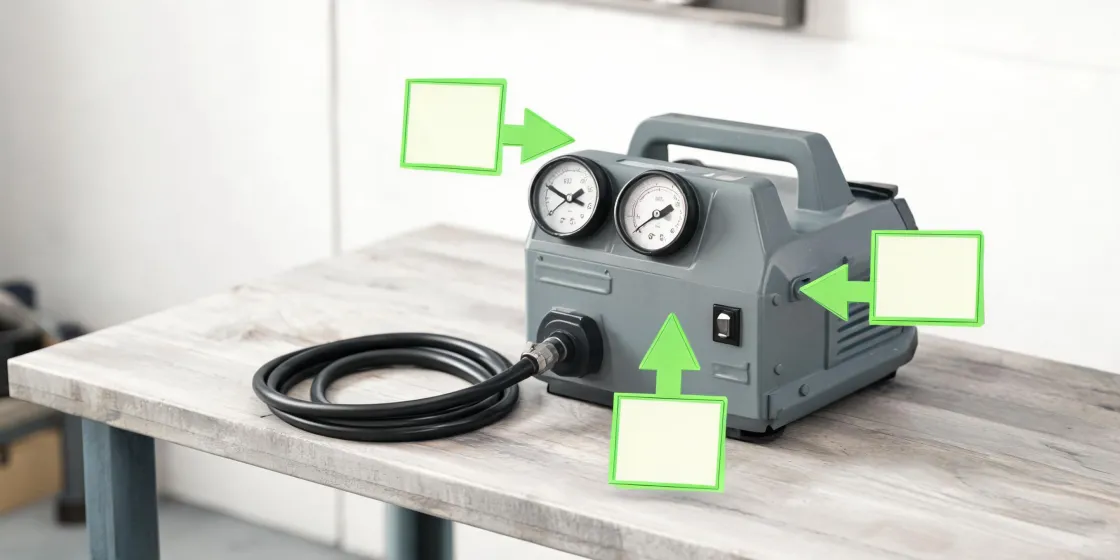
The comparison I run most often is between a 6 gallon air compressor and a California Air Tools 8 gallon air compressor, usually the California Air Tools 2010A that foremen love to request. Here's how I compare them, and why one project in spring 2023 changed the way I order.
Let me rephrase that: I don't compare the units first. I compare what the crew will be doing with them for the first month. The compressor is just the box that delivers the air.
The comparison framework I use
When I review quotes, I look at four dimensions:
- Air demand from the actual nailers on the job
- Recovery time when the tank does drain
- Portability and noise on real job sites
- Total cost, including what the box does not include
There's a reason I don't open with "six gallons versus eight gallons." Tank size matters, but because of how nail guns consume air, it's rarely the most important number.
Dimension one: nail gun air pressure and volume
Nail gun air pressure is where everyone starts, and it's the easiest number to get right—it's stamped on the tool or in the manual. Most finish nailers run in the 70–100 PSI range; many framing nailers want 100–120 PSI. Set the regulator to the gun's recommendation, not the compressor's maximum. I've watched a brand new trim carpenter overdrive a finish nailer at 120 PSI because the dial said so, and the result was nail heads countersunk a quarter inch into trim.
But here's what most first-time buyers miss. Pressure is only half of the answer. Every nailer extends a piston that consumes air, and consumption is measured in SCFM. A brad nailer sipping air at a leisurely pace is one thing. A framing nailer driven continuously by two guys sheathing plywood is another. The compressor has to deliver enough volume at the required pressure, continuously.
For a brad nailer or a single finish nailer, a 6 gallon air compressor with a reasonable SCFM rating will often keep up all day. For a framing nailer on production work, that same tank becomes a bottleneck—not because of pressure, but because volume runs out faster than the pump can replace it.
The conclusion on dimension one: size the compressor by your most demanding nailer, not by the nailer the crew plans to use on day one.
Dimension two: recovery time, where the California Air Tools 2010A changes the math
When I took over purchasing in 2020, I bought by price and tank size. That is how I ended up approving a 6-gallon compressor for a crew that hung door frames and sheathed a small wall in an occupied office building. By 10 a.m. the crew lead called me. Actually, let me be honest: he did not call me. He texted the operations manager, who called me. The tank kept emptying, the small pump kept running, and the framing nailer kept losing power. We finished the job by swapping in an 8-gallon from another location and paid overtime to make up the lost afternoon.
That is why I look at recovery. The California Air Tools 2010A is an 8-gallon unit with a 2.0 HP motor. Most small 6-gallon ultra quiet compressors in the same conversation run a 1.0 HP or 1.2 HP motor. The 2010A also runs on a standard 120-volt circuit, meaning our crews do not have to hunt for a 240-volt outlet or pay an electrician to add one. Those details matter when you buy for a maintenance team that works in unfamiliar buildings.
I don't have the exact recovery time memorized—I would have to pull the current spec sheet, and manufacturers update documentation—but the trend is consistent. A 2.0 HP motor gives the pump more capacity to refill the tank than the smaller motors typical of the 6-gallon quiet class, and it is refilling only two extra gallons. On an 8-gallon tank, that translates into shorter cycles and less time standing around waiting for pressure to build.
Here's what surprised me, and it's the counterintuitive part of this whole comparison: for an intermittent finish nailer, the larger tank hardly matters. One person installing trim stops often enough that a 6-gallon unit will recover. You buy the 8-gallon for duty cycle, not for the two extra gallons. If you're shooting a few nails a minute, the smaller tank barely empties.
The conclusion on dimension two: need continuous shooting or multiple tools running at once? Pay for the 2010A. Need occasional trim work? The larger tank is nice, but not decisive.
Dimension three: portability and noise
Pick up an 8-gallon 2010A and carry it up two flights of stairs, and you will want a 6-gallon. I will not pretend otherwise. The 8-gallon is heavier. If your crew moves the compressor every single day and wrestles it in and out of a van, choose lighter. For us, the 2010A almost never sees stairs. It rides on a two-wheel hand truck to a freight elevator. In buildings without freight elevators, we plan accordingly.
Because the California Air Tools brand is built largely on quiet compressors, the noise difference between their 6-gallon and 8-gallon models is smaller than people expect. But "ultra quiet" doesn't mean silent. I can still hear the 2010A run in a hallway; I just don't have to raise my voice to talk over it. No compressor in this category is absolutely silent, and anyone who promises you that is overselling.
A quick note on spec-sheet trust: Per FTC advertising guidance (ftc.gov), marketing claims need evidence and should not mislead. When a manufacturer publishes a dB(A) reading and an SCFM at 90 PSI, those are the defensible numbers. I compare those, not adjectives like "ultra quiet" or "high output." What spec sheets cannot tell you is acoustics in a tiled stairwell or a tiny mechanical room. If noise is critical, test the actual unit in a similar space.
The conclusion on dimension three: if the compressor moves daily, carry the 6-gallon. If it moves once per job and quiet matters, the 8-gallon is not the penalty you would expect.
Dimension four: the cost that the quote doesn't show
Here is where my transparent-purchasing habit takes over: I've learned to ask "what's NOT included" before I ask "what's the price." A low base price for a compressor means nothing if the crew still needs hoses, a regulator, fittings, and the actual nail gun. Some vendors sell the unit cheap and make it up on accessories; others list everything upfront. The vendor who lists all costs up front—even if the total looks higher—usually costs less in the end.
The 6-gallon is less expensive in the catalog. But that one overtime afternoon after the 6-gallon failed cost us more than the price difference between the two compressors. I still kick myself for not checking the SCFM rating before approving that first order. The invoice looked good; the job site result was not. For a business, the cheaper one can be the more expensive purchase, especially when the crew loses productive hours.
When I price the 2010A, I also check parts availability. Replacement filters, regulators, and rebuild kits are sold openly on the manufacturer's site. That may seem minor, but a compressor that sits in a service van waiting on one small part helps no one. A crew waiting all morning for a $15 filter has cost us far more than a premium compressor ever did.
The conclusion on dimension four: transparent pricing—upfront price, published specs, and available parts—beats a sticker price that hides the true cost of making the setup work.
What I actually order now
If you are asking "what compressor do I need for a nail gun," start with the nail gun. Here is my rule of thumb after years of purchase orders:
Order a 6 gallon air compressor when:
- The crew is doing trim, casing, brad, or pin work
- Use is intermittent—most interior finish work fits this
- The compressor will be lifted daily or carried up stairs
- Budget is fixed and finish work will not outrun recovery
Order the California Air Tools 8 gallon air compressor (2010A) when:
- Framing nailers or high-volume sheathing are on the schedule
- Two or more crew members work off one air supply
- The crew stays on a floor for days or has a cart and elevator available
- You want the faster-recovering 2.0 HP setup for continuous shooting
That last bullet matters. If I know a crew will touch a framing nailer even once a month, I now order the 2010A. The lighter 6-gallon stays on the shelf for punch lists and finish work. In our fleet, the answer to "what air compressor do I need for a nail gun" changed from "whatever fits the budget" to "whatever fits the biggest nailer." Since spring 2023, that policy has not caused a single "come quick, the compressor can't keep up" call.
That calculation might differ for you. We are a 30-person regional company doing commercial maintenance and light renovation, not a production framing crew running nail guns eight hours a day. If you are in high-production framing, an 8-gallon will honestly frustrate you—step up to a 10- or 15-gallon class. But for most B2B maintenance and trade work, the demand, recovery, mobility, and total cost comparison above will steer you right.
One more piece of advice: whatever you order, check the manual and set the nail gun air pressure to the tool manufacturer's recommendation. A compressor can deliver more pressure than a finish nailer should ever use.

Maren Jorgensen
Maren Jorgensen is an independent hand tool and torque applications analyst covering wrenches, pliers, screwdrivers, hammers, sockets, ratchets, hex keys, and tool sets. She applies ISO 6789-1 torque-tool conformance principles while examining jaw capacity, leverage, fastener engagement, torque range, accuracy, handle geometry, and material hardness. Her practical guides help tradespeople and procurement teams select suitable tools, plan controlled tightening, and compare durability without relying on brand reputation alone.