The Morning Our Porter-Cable Air Compressor Quit — and What It Taught Me About Checking Things Before They Break
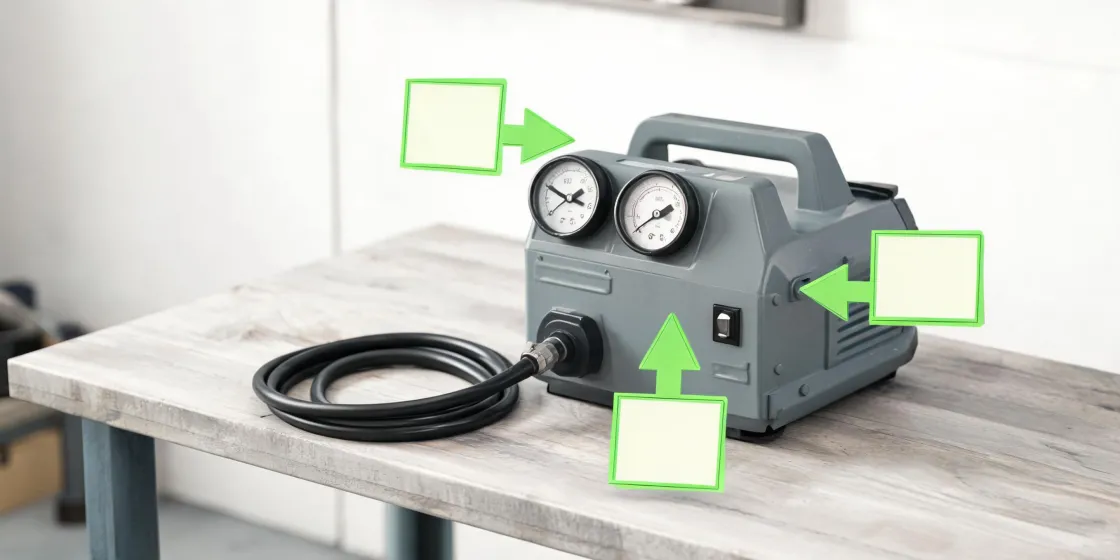
7:42 a.m., Tuesday. No Warning.
The compressor died somewhere between the second and third nail of the morning. No rattle, no warning light, no slow build-up. Just the abrupt silence of a dead motor and the faint hiss of air escaping somewhere it shouldn't.
I'm a quality and brand compliance manager for a mid-size renovation outfit in Central Texas. I review everything before it reaches a job site or a customer—roughly 300 items a quarter, everything from cabinet hardware to finished millwork. I've rejected about 14% of first deliveries in 2024 for spec issues, visible defects, or documentation gaps. My entire job is catching problems before they cost us.
And yet there I was, standing over a dead Porter-Cable air compressor with 36 hours until a contractor client's final walkthrough. We needed compressed air for the finish nailers on a cabinet install, and I had zero PSI. Zero.
That's the part I should've seen coming—and didn't.
The Five-Minute Fix I'd Been Ignoring for Eleven Months
I called a local repair tech, and he showed up by 1 p.m. He opened the drain valve on the tank bottom and a stream of rusty water shot out—maybe three cups' worth. Then he pulled the valve cover. The interior was a mess of corrosion and scale. Moisture had been accumulating inside that tank for months, slowly eating the intake valve and the pressure switch.
"This didn't happen overnight," he said. "I see this on two out of every five compressors I service. People drain the tank maybe once a year—if that. But the manual says after every use, or at minimum once a week. Every week."
The repair ran $340 in parts and labor. We also had to rent a backup compressor for two days—another $180—because the job couldn't wait. Total damage from a maintenance task that takes about 90 seconds: $520, plus the near-miss on a client relationship.
Here's what most people don't realize about air compressor failures in a shop environment: they almost never announce themselves. The pressure gauge might hover a little lower than usual for weeks. You might notice a bit more water in the tank than before. But unless someone's actually tracking those small indicators, you won't see the failure coming. And by the time you hear that silence, you're already past the point of a cheap fix.
I'd checked every spec sheet, every finish sample, every hardware pull in that job. But the machine that made the whole install possible? Never once crossed my checklist.
The Unexpected Lesson from a Hose Clamp
While the technician worked, he asked me to hold the air line steady while he popped off the old hose clamp. I'd never really thought about how to unlock a hose clamp—turns out there are two main types, and the process differs depending on what you're holding. Screw-type clamps need a flathead or a 5/16-inch nut driver. Spring-type clamps need either a specialty pliers or a good pair of slip-joint pliers to squeeze the tabs and slide the clamp down the hose.
He used a pair of worn Cobra pliers—the water-pump style with the self-locking jaw—and it took him maybe ten seconds. "A lot of folks try to use whatever's in their pocket and end up kinking the clamp or stripping the screw," he said. "Then they're off to the hardware store for a $4 part and losing half an hour. A decent pair of pliers pays for itself in a month."
I filed that away. I also found out later that week that Cobra pliers were on sale at one of the big online tool retailers—about $20 instead of the usual $30 for the 10-inch version. I bought a pair for the shop, and honestly they've become the most borrowed tool we own. Sometimes a deal on something simple like pliers is a bigger deal than it looks.
Applying the Same Logic to Everything Else
I went back to my office that afternoon and started a 12-point weekly equipment checklist. Drain the compressor tank. Check the oil level. Test the GFCI on the bench outlets. Inspect air hoses for cracks. It takes about ten minutes every Friday afternoon.
That checklist caught a second compressor problem in June 2024—pressure was dropping below 80 PSI under load—and we scheduled a service call before it turned into another $500 emergency.
Around the same time, our old cordless hammer drill was on its last legs. The chuck wobbled, the batteries were down to maybe 15 minutes of run time. We replaced it with a Porter-Cable cordless hammer drill kit (model PCCK602LB, 20V, two batteries). At $179 it wasn't the cheapest option, but it was the one that fit our existing battery platform.
But this time I didn't just hand it off to the crew. I ran a 30-day checkpoint test—recorded battery performance, checked chuck runout with a dial indicator (0.004 inches, within spec), ran it through 47 concrete holes with a 1-inch bit over two days. The motor never got too hot to touch, and the battery still showed two bars after the last hole. That's not a lab test, but it's exactly the kind of data I trust.
And then there was the cabinet door hinge in our shop kitchen. It had been sagging for weeks—I kept meaning to fix it, kept not doing it. I finally looked up how to adjust cabinet door hinges: there are three screws on a European-style hinge (the cup hinge, that is). The one closest to the door edge controls the door's side-to-side position. The middle one controls depth. The one on the back controls height. Quarter-turn adjustments, test, repeat.
Ninety seconds of work. That's it. I'd been avoiding it for a month. Which is exactly the same pattern that cost me $520 on that compressor.
What This Actually Cost—and Saved
I won't pretend I have precise numbers for every dollar saved. But here's what I do know: between March and December 2024, we spent about $1,100 on scheduled maintenance across our equipment—compressor service, blade sharpening, drill servicing. During that same period, we had no unplanned equipment downtime on jobs. Zero emergency rentals.
The year before, we'd spent roughly $2,800 on emergency repairs and rentals. So that's a delta of about $1,700 in savings, with the added benefit of not having to explain to a client why their walkthrough got delayed.
The 12-point checklist itself took maybe 30 minutes to create. The pliers cost $20. The hinge adjustment took 90 seconds. The compressor repair cost $520 because I didn't check the drain valve for eleven months.
I'm not saying I've got it all figured out. We missed a checklist week in August (the shop was slammed), and sure enough, the compressor started making a noise I didn't like. We caught it early enough that it was a $40 fix instead of another $500 problem. But the pattern is clear: the earlier you check, the cheaper everything gets.
If you run a shop or manage tools for a crew, try this: take 15 minutes this Friday afternoon. Drain the compressor. Check the drill chucks. Tighten the hinges on the cabinet doors in your office. You'll probably find something you've been putting off. Fix it now. Trust me on this one—5 minutes of checking beats 5 days of fixing.

Darius Campbell
Darius Campbell is an independent power tool and cordless systems analyst covering drills, impact drivers, impact wrenches, grinders, circular saws, rotary hammers, and jigsaws. He uses IEC 62841-1 safety requirements while comparing rated input, battery voltage, torque, no-load speed, duty cycle, vibration, dust control, runtime, and accessory compatibility. His evaluation articles help contractors and buyers match tool platforms to workload, mobility, service conditions, and total battery-system cost.